A Generated Protein Is Not a Result: Protein Design in 2026
“Design a soluble binder to this epitope” sounds like a commission. It is closer to a search-box query.
Here is a version an experiment could reject. Start from a supplied structure of a prefusion influenza A H1 haemagglutinin (HA) trimer and mark one solvent-exposed stem patch by chain, residue, and atom. Ask for a 70–120-residue monomer that is expressed solubly in E. coli, remains monodisperse by size-exclusion chromatography, and has an apparent melting temperature of at least 60 °C. The primary endpoint is surface plasmon resonance at 25 °C with . An epitope-mutant target and a matched irrelevant glycoprotein are negative controls. These are acceptance criteria, not results.
Part 2, A Protein Embedding Is Not an Explanation, separated a learned representation from the head and protocol that made it useful. Moving from representation to generation adds another boundary: a model can propose a plausible molecule without establishing that it can be made, folds as intended, or performs the requested job. The practical question is therefore not “Which model is best?” It is “Which object must be proposed, and which experiment could reject it?”
Choose the generated object before the model
“Protein generation” names several different transactions. A model may return a string of amino acids, coordinates without a sequence, or a more atomistic complex. Each leaves a different unpaid bill downstream.

Figure 1. Original synthesis: generated objects and the downstream work they require. Conceptual sources: RFdiffusion, RFdiffusion2, ProteinMPNN, LigandMPNN, the ESM3 developer manuscript, and Protpardelle.
The required downstream work follows from the object, not the brand. A backbone generator does not return a gene. An inverse-folding model does not invent a topology. A joint sequence-structure model may remove one computational hand-off, but synthesis, purification, and the endpoint assay remain.
For the binder commission, the first plausible route is a target-positioned binder backbone followed by inverse folding, refolding, interface filters, diversity selection, synthesis, and experiment. A family-conditioned sequence model would be more direct if the actual request were “sample another lysozyme-like sequence.” An enzyme commission with fixed catalytic atoms but unknown residue identities needs unindexed atom-level scaffolding instead. Model selection begins only after that distinction is frozen.
Five mechanisms, three operational questions
Terms such as diffusion and autoregression help only when they answer three questions: What is ordered or corrupted? What does the network predict? What usable artifact emerges?
Next-token autoregression orders a sequence, except when it orders structure
Original ProGen orders amino acids from left to right. The network predicts the next-residue distribution from the prefix; repeated sampling returns a sequence. The 1.2-billion-parameter model was trained on more than 280 million protein sequences. ProGen2 studied decoder models from 151 million to 6.4 billion parameters and warned that capturing a training distribution is not the same as measuring molecular fitness. Temperature and nucleus sampling change sequence novelty, so the sampling configuration belongs in the method, not in a forgotten notebook.
Autoregression can also describe geometry. In the PAR paper, presented as an oral at ICML 2026, the ordered object is a coarse-to-fine sequence of structural scales. A transformer supplies conditional embeddings and a flow decoder produces a backbone. PAR is a useful counterexample to a common shortcut: the objective name does not reveal whether the output is an amino-acid string or three-dimensional geometry.
Masked iteration revises discrete tracks
The ESM3 developer manuscript describes masked generation over discrete sequence, structure, and function tracks. The network predicts missing tokens, and an iterative schedule can fill or revise unspecified regions and modalities. Depending on the prompt, the usable artifact may be a sequence, structure tokens, or a mixed completion.
The manuscript describes research systems trained at 1.4, 7, and 98 billion parameters. That list does not make the 7B or 98B weights downloadable. ESM3-open is a separate artifact with its own terms, so record the exact checkpoint and access route rather than inferring either from the family name.
Discrete diffusion corrupts categories
EvoDiff can replace amino acids according to a categorical transition matrix until the sequence approaches a uniform sample; a network learns to reverse that corruption. The returned object is a sequence, which makes inpainting and sequence-level motif completion natural operations. DPLM likewise diffuses amino-acid tokens. The developer-preprint evidence for DPLM-2 adds quantized structure tokens, so multimodal generation depends on the tokenizer and decoder as well as the diffusion model.
Continuous diffusion corrupts geometry
Coordinate or frame diffusion starts from corrupted three-dimensional geometry. A network predicts the information required to reverse that corruption over multiple steps. Original RFdiffusion generates protein backbones under task-specific conditioning. Chroma combines correlated backbone diffusion with sequence and side-chain generation. Protpardelle diffuses a continuous superposition of residue and side-chain states, then collapses it to discrete identities and conformations. Shared mathematics does not make their output contracts interchangeable.
The original RFdiffusion figure makes the generated artifact visible: geometry is noised, then denoised into a protein backbone under a declared conditioning mode.
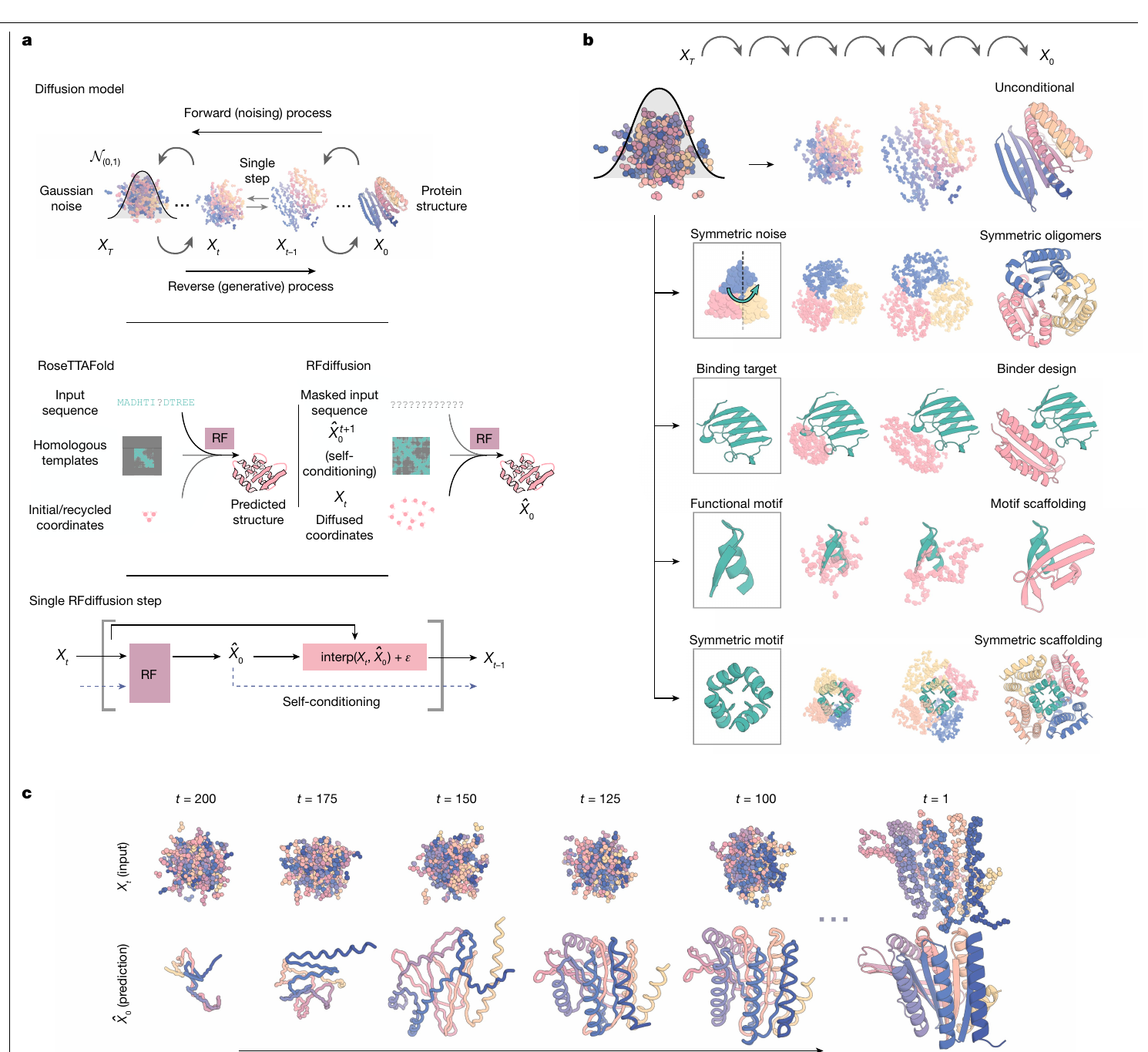 Figure 2. RFdiffusion's noising and denoising process, architecture change, and design modes. Source and authors: Joseph L. Watson et al., “De novo design of protein structure and function with RFdiffusion.” Licensed under CC BY 4.0; cropped; scientific content unchanged.
The figure shows how one backbone denoiser supports different geometric constraints. The sequence-design and assay stages are absent from the generated object. They have not disappeared from the experiment.
Flow matching predicts a transport field
Flow matching chooses a source distribution, often noise, and learns a time-dependent vector field that transports samples toward protein geometry. Numerical integration returns coordinates or residue frames. FrameFlow and FoldFlow apply the idea on residue rigid motions. The Proteina developer preprint uses flow matching for backbones and reports training on up to 21 million filtered, synthetic structures derived from the AlphaFold Protein Structure Database (AFDB), a provenance detail that belongs beside its results (Proteina). La-Proteina instead combines explicit coarse backbone coordinates with per-residue latents that decode to sequence and atomistic detail.
Fewer integration steps can be an operational saving under a matched implementation. It says nothing by itself about expression, affinity, or function. For the binder commission, flow versus diffusion matters only after both routes can represent the target, epitope, desired binder object, and downstream sequence-design stage.
Keep inverse folding as its own stage
Once a backbone exists, it needs a sequence. ProteinMPNN proposes amino acids conditioned on protein-backbone geometry. LigandMPNN adds nearby small-molecule, nucleotide, or metal atoms and can also generate side-chain conformations. Neither system creates the backbone it consumes.
LigandMPNN's architecture makes the direction of conditioning unusually clear: structure and atomic context enter on the left; sequence and packed side chains emerge on the right.
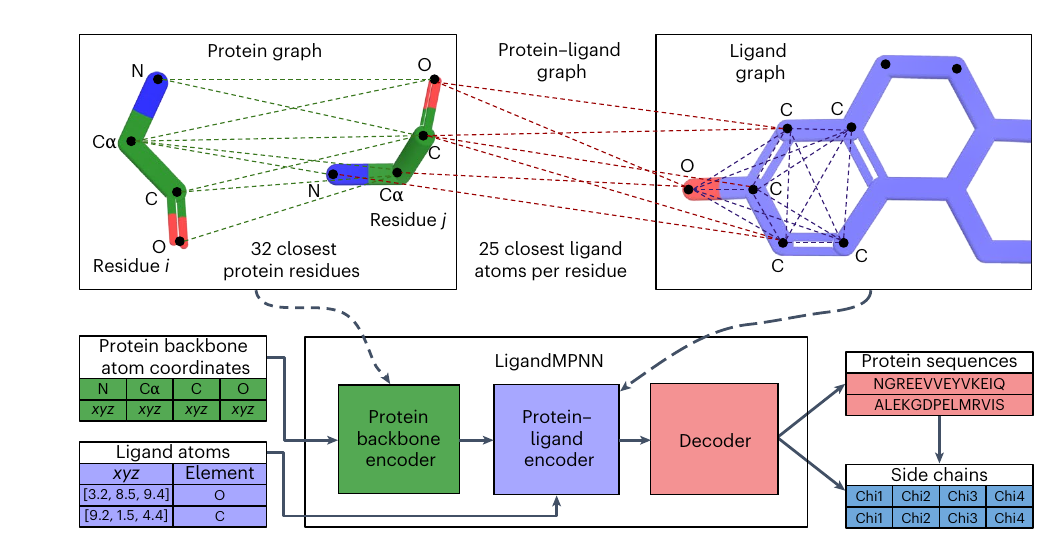 Figure 3. LigandMPNN's fixed-backbone, atomic-context inverse-folding architecture. Source and authors: Justas Dauparas et al., “Atomic context-conditioned protein sequence design using LigandMPNN.” Licensed under CC BY 4.0; cropped; scientific content unchanged.
Native sequence recovery is a valid benchmark for agreement with known proteins under a declared test set. It is not the objective of a de novo binder. A sequence can differ from nature and work; it can also recover familiar residues and fail to bind. For the HA commission, record sequences sampled per backbone, sampling temperature, fixed positions, explicit target context, and the refolding policy. Those choices can change which backbone later appears “designable.”
RFdiffusion is a lineage, not an upgrade ladder
Original RFdiffusion fine-tunes a structure-prediction network for protein-backbone denoising. It supports unconditional backbones, symmetry, indexed motif scaffolding, and target-conditioned binder backbones. The official repository also describes a separate ProteinMPNN and AlphaFold-based filtering workflow (RFdiffusion repository).
The motif figure below is useful because computational scaffold criteria and selected functional measurements remain visibly different kinds of evidence.
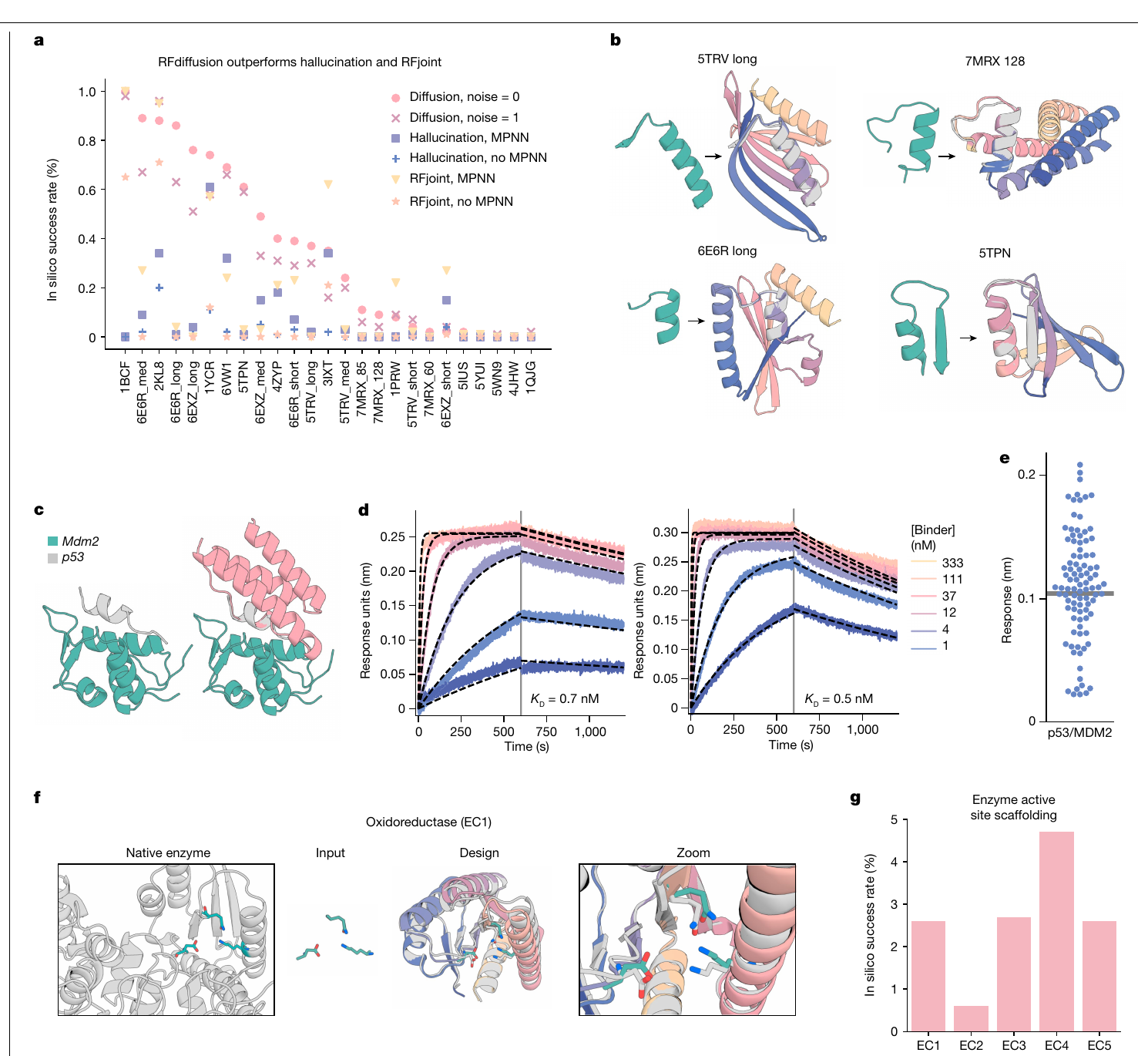 Figure 4. RFdiffusion motif-scaffolding benchmarks, examples, and selected experimental measurements under the paper's protocols. Source and authors: Joseph L. Watson et al., “De novo design of protein structure and function with RFdiffusion.” Licensed under CC BY 4.0; cropped; scientific content unchanged.
RoseTTAFold All-Atom is the mixed-assembly predictor; RFdiffusion All-Atom is a separate generative branch obtained by fine-tuning it for structure denoising. RFdiffusionAA builds protein structures around explicit small molecules. Its official implementation warns that the generated residue identities are not usable sequences, apart from a supplied motif, so an inverse-folding stage such as LigandMPNN remains necessary. Its implementation and terms must be audited separately from original RFdiffusion, RFdiffusion2, and Foundry/RFdiffusion3.
RFdiffusion2 solves a narrower but important problem: it generates enzyme scaffolds from functional-group geometry without assigning residue order in advance. The authors report an in-silico comparison spanning 41 active-site problems and separate prospective experiments in which active candidates were found for three catalytic mechanisms after fewer than 96 selected sequences per campaign. The initial public release described itself as inference-only and makes the next stages explicit: LigandMPNN sequence fitting followed by structure prediction (RFdiffusion2 repository).
RFdiffusion3 is a separate 2025 developer preprint and current Foundry artifact. It generates protein structures in the context of ligands, nucleic acids, and other non-protein atom constellations. The preprint reports DNA-binding and cysteine-hydrolase experiments but provides no general campaign denominator in its abstract. Foundry keeps generation, MPNN inverse folding, and structure prediction as different tools. There is no sound reason to transfer benchmark results or access terms between these releases merely because their names rhyme.
A binder campaign is a funnel, not a sample image
The original RFdiffusion binder work is directly relevant to the running commission. The authors experimentally characterized hundreds of designed assemblies, metal-binding proteins, and binders in aggregate, and one highlighted influenza-haemagglutinin binder complex closely matched its design by cryo-EM. After AlphaFold2 filtering, the authors selected 95 designs for each of five targets and reported a 19% overall single-point biolayer interferometry (BLI) success rate, defined as binding at or above 50% of the positive-control maximum (RFdiffusion paper). That is a selected-to-assayed result. Without the raw generated and prefilter counts, it is not a portable generator hit rate. The result belongs to the whole campaign, not the generator alone.
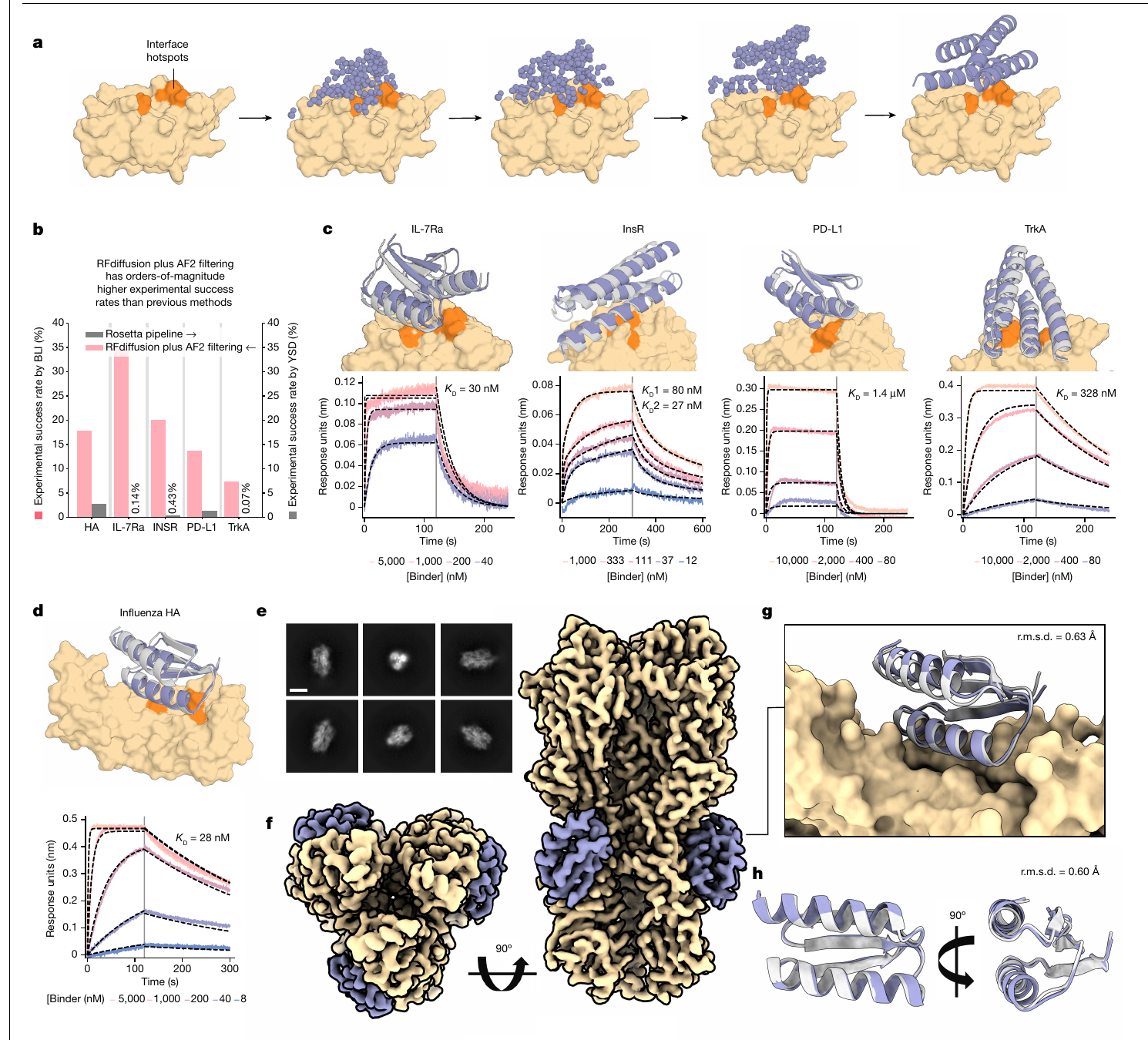 Figure 5. RFdiffusion binder generation, author-reported campaign results, binding curves, and a highlighted influenza-haemagglutinin binder complex. Source and authors: Joseph L. Watson et al., “De novo design of protein structure and function with RFdiffusion.” Licensed under CC BY 4.0; cropped; scientific content unchanged.
For a new HA epitope, the figure is precedent for a workflow, not a yield forecast. A different target construct, filter stack, expression setup, and specificity panel define a different experiment.
Sequence and joint generators have the same denominator problem. In the ProGen lysozyme study, 66 of 90 assayed artificial proteins met the paper's functional criterion after family fine-tuning, generation-quality ranking, and diversity selection. The number is a selected-assay result, not a base-model hit rate. Chroma's authors experimentally characterized 310 selected proteins, while the roughly 1 Å agreement applied to two solved crystal structures, not the full cohort (Chroma).
ESM3 supplies an even clearer funnel. Iterative optimization of selected starts across 30 iterations produced a pool of 67,000 designs that included every iteration. Explicit filters and ranking terms then selected 88 designs across sequence-identity buckets for the first plate. Those 88 were synthesized, expressed in E. coli, and assayed for fluorescence. The highlighted fluorescent protein is evidence for that selected path. The paper title's “500 million years” is an evolutionary-distance estimate, not literal simulated time or a model-wide success rate (developer manuscript; Science article).
A predictor can grade its own ecosystem
A common backbone benchmark works like this: generate a structure, sample several ProteinMPNN sequences, refold each sequence with ESMFold or AlphaFold, select the best attempt, and threshold self-consistency root-mean-square deviation (scRMSD) or TM-score. One FrameFlow protocol sampled ten backbones at every length from 60 to 128, generated eight ProteinMPNN sequences per backbone, and folded all eight with ESMFold. A FoldFlow protocol used ProteinMPNN, ESMFold, a declared length grid, and an scRMSD threshold of 2 Å.
Eight attempts create eight chances to please the oracle. The reported number belongs to the generator, inverse-folding checkpoint, temperature, attempt count, predictor version, best-of-n rule, and threshold together. As an inference from that documented oracle stack, reusing a related structure model for both selection and success scoring risks preserving correlated errors. Novelty also depends on search method, cutoff, and database date. Training or structural overlap can make familiar folds look easy. Results built from different datasets, length bins, predictors, or thresholds do not form a leaderboard; ProteinBench explicitly notes that inconsistent training data hinder direct architecture comparisons.
Even corpus size counts different things. The EvoDiff repository and DPLM repository each describe training sequence models on about 42 million UniRef50 sequences. The ESM3 developers report billions of sequence records plus structure and function tracks, while also stating that the structural corpus includes predictions and that inverse-folded synthetic sequences were added (ESM3 developer manuscript). Proteina's 21-million-structure set is filtered, synthetic, and AFDB-derived. Record those origins before treating novelty, scale, or held-out performance as biological generalization.
The evidence contract should make ownership and attrition impossible to hide.

Figure 6. Original synthesis: an auditable separation of generator, sequence design, oracle, filters, ranker, and experiment. Conceptual sources: the oracle protocols in FrameFlow, FoldFlow, and Protpardelle, plus the experimental calibration design in COMPSS.
Keep three broad evidence levels distinct. Generator-native and geometry metrics say whether a sample fits a computational objective. Oracle-mediated metrics say whether another model agrees under a declared protocol. Experimental layers establish detectable production, purification, biophysical state, affinity, specificity, catalysis, or another biological endpoint. Evidence at one level can justify spending money on the next. It cannot substitute for it.
In this workflow, pLDDT, pTM, PAE, self-consistency RMSD and TM-score, sequence recovery, novelty, perplexity, predicted energy, and interface scores are computational filters. None directly measures expression, experimental folding, affinity, specificity, catalysis, safety, or manufacturability; calibrate each against the assay that matters.
Calibrate the filter against the experiment
The COMPSS study asked whether computational scores predict measured enzyme activity. It evaluated 20 metrics and expressed and purified more than 500 natural and generated sequences from two enzyme families. The generated sequences remained 70–90% identical to their nearest natural sequences, so this was not a de novo-backbone test. Across naive generation, calibration, and validation rounds, the authors reported that a composite filter improved experimental success by 50–150% within their own two-family setup.
The workflow, rather than the improvement range, is the transferable result.
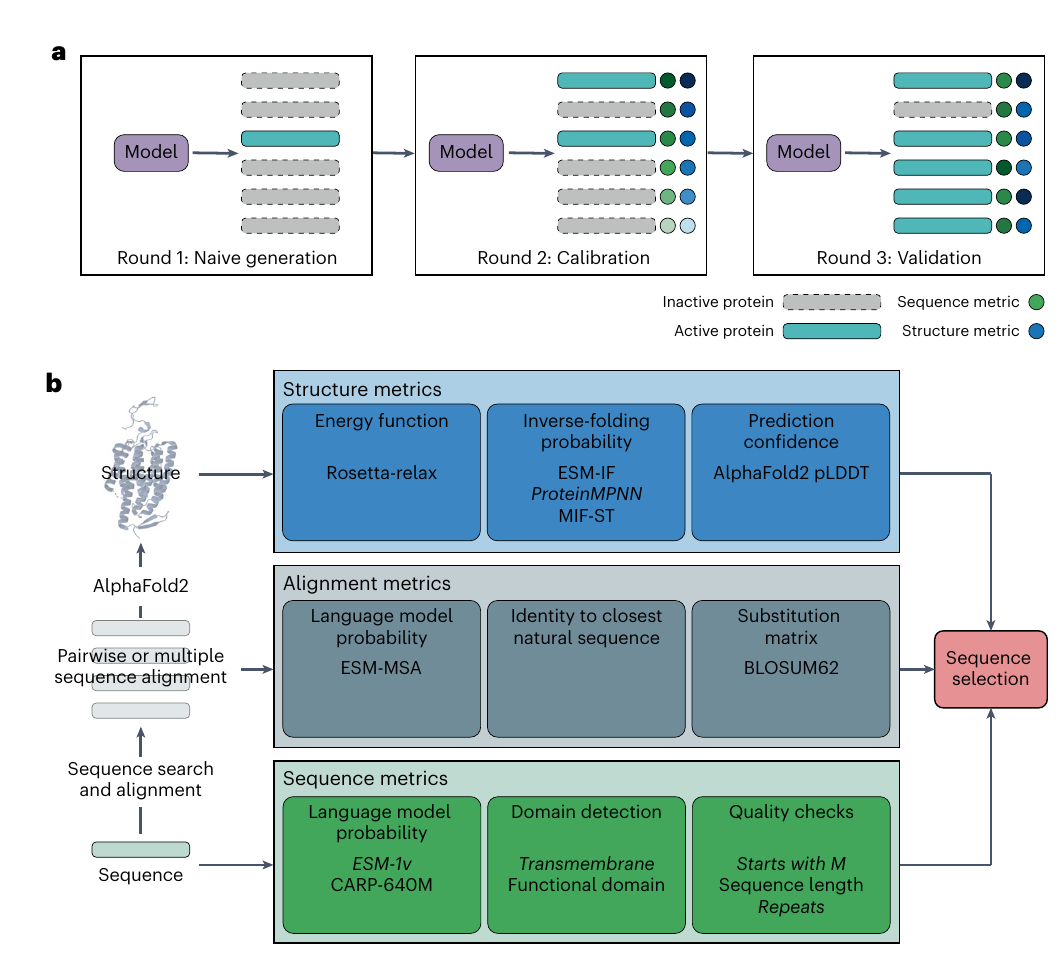 Figure 7. The COMPSS design-and-selection funnel across naive generation, calibration, and validation rounds. Source and authors: Sean R. Johnson et al., “Computational scoring and experimental evaluation of enzymes generated by neural networks.” Licensed under CC BY 4.0; cropped; scientific content unchanged.
For the HA binder, run a bounded pilot and ask whether the ranking enriches the declared affinity and specificity assay. Attrition is not housekeeping. It is the result: generation failures, invalid structures, filter rejects, synthesis failures, insoluble expression, purification losses, aggregation, weak binding, and off-target binding diagnose different stages.
Compare artifacts you can actually run
Access is part of task fit. The table below is a dated 2026-08-28 snapshot, not legal advice or a performance ranking. “Not established” means exactly that; it never means unlimited.
| Object gate and exact artifact | Generated object and conditioning | Verified scale, length, or compute boundary | Code, weights, service, data, dependencies, outputs | Decision for the running commission |
|---|---|---|---|---|
| RFdiffusion official repository | Protein backbone from topology, motif, or target context | Context ceiling and reproducible inference cost were not established in the reviewed facts | BSD terms expressly cover repository source code and README-referenced weights. Service, data, dependency, and output terms were not established | Plausible binder-backbone route; still requires inverse folding, refolding, filtering, and assay |
| RFdiffusion2 initial inference release | Scaffold from unindexed functional atoms | One heavily atomized 150-residue demo may take up to ten minutes per case on an RTX 2060; this is not a general speed estimate | Inference access is documented. Exact code, weight, data, dependency, service, and output terms were not established in the verified pack | Fits catalytic-atom scaffolding, not the first HA-binder route |
| ESM3-open | Masked sequence, structure, and function-token completion | The open checkpoint is separate from the 1.4B, 7B, and 98B research-scale list. Its exact context and compute were not established | Current repository code is MIT. ESM3-open weights and defined outputs or derivatives have separate Cambrian Non-Commercial terms. Service, data, and dependencies require separate checks | Useful for multimodal editing; a geometric binder commission still needs an explicit target-interface and assay route |
| Chroma pretrained artifact | Structure and sequence under geometric or semantic constraints | Developer timing lacks a fixed GPU, size, and sampling protocol; exact context policy was not established | Repository code is Apache-2.0. Pretrained weights require an API key and acceptance of the Chroma Parameters License; the README describes access for academic researchers and non-profit entities and directs commercial or beyond-scope users to the licensor. Full weight-agreement, service, data, dependency, and output terms require separate checks | Candidate for programmable joint design only after exact terms and target-context support pass |
| La-Proteina repository | Sequence and atomistic protein structure through an autoencoder plus latent-diffusion model | Separate checkpoints support motif scaffolding up to 256 residues, unconditional generation up to 500, and a 300–800-residue long-chain route; reproducible sampling cost was not established | Code is Apache-2.0; weights use the NVIDIA Open Model License; other materials are CC BY 4.0. Service, data, dependencies, and outputs were not established | Atomistic monomer co-generation is not yet evidence of target-conditioned binder fit |
| ProGen3 public release | Forward, reverse, and infill protein-sequence generation, plus sequence scoring | Public checkpoints span 112M to 3B parameters. The scoring CLI accepts sequences up to 8,190 residues, which does not establish the generation limit. The developer reports testing on A100/H100 GPUs with at least 40 GB VRAM | Repository code is Apache-2.0; weights are CC BY-NC-SA 4.0. The separately announced 46B research system is not one of these public checkpoints. Data, dependencies, services, and output terms require separate checks | A sequence-family route, not an atomic epitope specification |
Model scale and compute only help when they belong to the artifact being run. Original ProGen's reported training used 256 TPU v3 cores for two weeks (ProGen); FrameFlow reported training one model for one day on two A100 48 GB GPUs (FrameFlow); RFdiffusion2 reported a specific RTX 2060 demo time (RFdiffusion2 repository). Those facts describe different jobs and hardware, so they cannot rank inference cost. If a checkpoint's context length, memory requirement, or maximum chain policy is absent, put unknown on the experiment card.
The same scope firewall applies beyond the table. The DPLM and PAR repositories use Apache-2.0 for their software; the ProteinMPNN, LigandMPNN, and Protpardelle repositories use MIT for theirs. Those repository licences do not establish rights to weights, hosted services, training data, dependencies, or outputs; audit the terms for each exact artifact separately (DPLM, PAR, ProteinMPNN, LigandMPNN, Protpardelle). “Open” is not a field in an experiment card.
Write the experiment card before sampling
Part 1, A FASTA File Is Not a Specification required the predictive object and protocol to be declared before choosing a folding system. Generation makes that discipline more urgent because the candidate did not exist until the pipeline proposed it.
For the HA binder commission, the minimum defensible contract fits on one page:
- Biological endpoint and immutable context. Freeze the target construct, structure version, chain IDs, epitope atoms, allowed target relaxation, excluded glycans or cofactors, expression host, target affinity (), stability floor, assay method, and negative controls.
- Generated object and objective. State whether the first artifact is a target-conditioned binder backbone, a joint complex, or sequences for supplied geometry. Record what is ordered or corrupted and what the network predicts.
- Exact artifact and terms. Record model release, checkpoint, repository commit, weight source, code terms, weight terms, service terms, data, dependencies, output terms, context policy, and hardware. Use
unknownwhere evidence is absent. - Sampling budget. Predeclare backbones, retries, random seeds, diffusion or integration steps, sequences per backbone, temperatures, and any best-of-n rule. A generation failure stays in the denominator.
- Oracle and novelty stack. Freeze structure predictors, versions, templates, recycles, target handling, thresholds, database names and snapshot dates, sequence/structure cutoffs, overlap audit, and whether an oracle influenced training or generation.
- Filters and ranker. Record clash, geometry, interface, aggregation, and physicochemical filters plus the ranking formula. Do not tune thresholds after seeing the preferred survivors without calling it a new round.
- Preserved funnel and pilot assay. Count generated, parseable, filtered, clustered, synthesized, expressed, purified, monomeric, affinity-positive, and specificity-positive candidates. Use blinded SPR where practical, plus positive, epitope-mutant, and irrelevant-target controls.
- Stop or reconsider. Pause if the pilot yields no specific binders, if computational rank fails to enrich the assay, or if attrition concentrates at one stage. Diagnose that stage before increasing the synthesis budget.
The result is the candidate plus the complete, dated route to a measurement that could reject it.
Part 4 will test that rule where the specification tightens again: antibody models add paired-chain and interface constraints while the validation plan expands to specificity and developability.
References
- Watson JL et al. “De novo design of protein structure and function with RFdiffusion.” Nature 620, 1089–1100 (2023).
- RosettaCommons. “RFdiffusion official implementation.” Repository and licence, retrieved 2026-08-28.
- Ahern W et al. “Atom-level enzyme active site scaffolding using RFdiffusion2.” Nature Methods 23, 96–105 (2026).
- RosettaCommons. “RFdiffusion2 official implementation.” Repository, retrieved 2026-08-28.
- Butcher J et al. “De novo design of all-atom biomolecular interactions with RFdiffusion3.” bioRxiv developer preprint (2025).
- RosettaCommons. “Foundry.” Repository, retrieved 2026-08-28.
- Krishna R et al. “Generalized biomolecular modeling and design with RoseTTAFold All-Atom.” Science 384, eadl2528 (2024).
- Hayes T et al. “Simulating 500 million years of evolution with a language model.” Science 387, ads0018 (2025).
- Biohub. “ESM repository.” Code and model documentation, retrieved 2026-08-28.
- EvolutionaryScale. “Cambrian Non-Commercial License Agreement.” Retrieved 2026-08-28.
- Madani A et al. “Large language models generate functional protein sequences across diverse families.” Nature Biotechnology 41, 1099–1106 (2023).
- Nijkamp E et al. “ProGen2: Exploring the boundaries of protein language models.” Cell Systems 14, 968–978.e3 (2023).
- Profluent. “Introducing ProGen3.” Developer showcase (2025).
- Alamdari S et al. “Protein generation with evolutionary diffusion: sequence is all you need.” eLife Reviewed Preprint (2026).
- Wang X et al. “Diffusion Language Models Are Versatile Protein Learners.” ICML (2024).
- Wang X et al. “DPLM-2: A Multimodal Diffusion Protein Language Model.” ICLR (2025).
- Ingraham JB et al. “Illuminating protein space with a programmable generative model.” Nature 623, 1070–1078 (2023).
- Chu AE et al. “An all-atom protein generative model.” PNAS 121, e2311500121 (2024).
- Geffner T et al. “Proteina: Scaling flow-based protein structure generative models.” ICLR 2025; arXiv version cited.
- NVIDIA BioNeMo. “La-Proteina official implementation.” Repository and artifact terms, retrieved 2026-08-28.
- Qu Y et al. “Protein Autoregressive Modeling via Multiscale Structure Generation.” ICML 2026 Oral; arXiv manuscript cited.
- Yim J et al. “Fast protein backbone generation with SE(3) flow matching.” Preprint (2023).
- Bose AJ et al. “SE(3)-Stochastic Flow Matching for Protein Backbone Generation.” ICLR (2024).
- Dauparas J et al. “Robust deep learning-based protein sequence design using ProteinMPNN.” Science 378, 49–56 (2022).
- Dauparas J et al. “Atomic context-conditioned protein sequence design using LigandMPNN.” Nature Methods 22, 717–723 (2025).
- Ye F et al. “ProteinBench: A Holistic Evaluation of Protein Foundation Models.” ICLR (2025).
- Johnson SR et al. “Computational scoring and experimental evaluation of enzymes generated by neural networks.” Nature Biotechnology 43, 396–405 (2025).
- ByteDance. “DPLM family official implementation.” Repository, retrieved 2026-08-28.
- ByteDance Seed. “PAR official implementation.” Repository, retrieved 2026-08-28.
- Justas Dauparas. “ProteinMPNN official implementation.” Repository, retrieved 2026-08-28.
- Justas Dauparas. “LigandMPNN official implementation.” Repository, retrieved 2026-08-28.
- Protein Design Lab. “Protpardelle official implementation.” Repository, retrieved 2026-08-28.
- Generate Biomedicines. “Chroma official implementation.” Repository, retrieved 2026-08-28.
- Hayes T et al. “Simulating 500 million years of evolution with a language model.” bioRxiv developer manuscript (2024), underlying the later Science article.
- Microsoft. “EvoDiff official implementation.” Repository and model documentation, retrieved 2026-08-28.
- Baker Laboratory. “RFdiffusion All-Atom official implementation.” Repository and model documentation, retrieved 2026-08-28.
- Profluent AI. “ProGen3 public release.” Repository, model documentation, and artifact terms, retrieved 2026-08-28.
Comments and feedback
Spotted an error or have a counterpoint? Comment below. No account needed, a name is enough. Corrections and pushback are welcome.