A FASTA File Is Not a Specification: Protein Structure Prediction in 2026
Suppose somebody hands you a FASTA file and asks for “the structure.” First decide whether the target is one chain, a protein assembly or a mixed complex containing ligands or nucleic acids. You also need to know whether the sequence may leave your infrastructure, what compute is available, and what will be done with the answer.
Those are not procurement details. FoldBench, an independent comparison of five all-atom systems, used 1,522 assemblies spread across nine target types. The study treated protein monomers, protein-protein interfaces and protein-ligand interfaces as separate jobs, not interchangeable rows in one contest. The evaluation itself used five seeds, five samples per seed, ten recycles and NVIDIA H800 80 GB GPUs. A default one-shot run is not the same experiment. (Xu et al., 2026)
This is Part 1 of a six-part series on foundation models in biology. The aim here is not to rank nineteen structure systems. It is to explain how the field's architectural eras changed the choices an operator must make, then turn those choices into a practical selection procedure.
“Structure” names three different jobs
A monomer prediction asks for the geometry of one protein chain. Local folding and the placement of domains both matter, but even a good static structure is one hypothesis. In a study of fold-switching proteins, deep alignments carried stronger signal for a dominant conformation while shallower, subfamily-specific alignments carried more signal for an alternative. AlphaFold2 missed much of that alternative signal. (Chakravarty et al., 2024)
A protein-complex prediction adds chain placement and interfaces. A model can fold every chain convincingly and still assemble them incorrectly. AlphaFold-Multimer was published specifically for protein-complex prediction, while ColabFold's complex workflow creates separate component alignments, pairs them according to a selected mode, and uses interface-oriented confidence alongside local confidence. (Evans et al., 2021; Mirdita et al., 2022)
An all-atom biomolecular prediction expands the entity vocabulary to some combination of proteins, DNA, RNA, small molecules, ions and modified residues. AlphaFold3 was designed to predict their joint structures. Here the questions include ligand placement and atom-level geometry, not only backbone shape or protein interface quality. (Abramson et al., 2024)
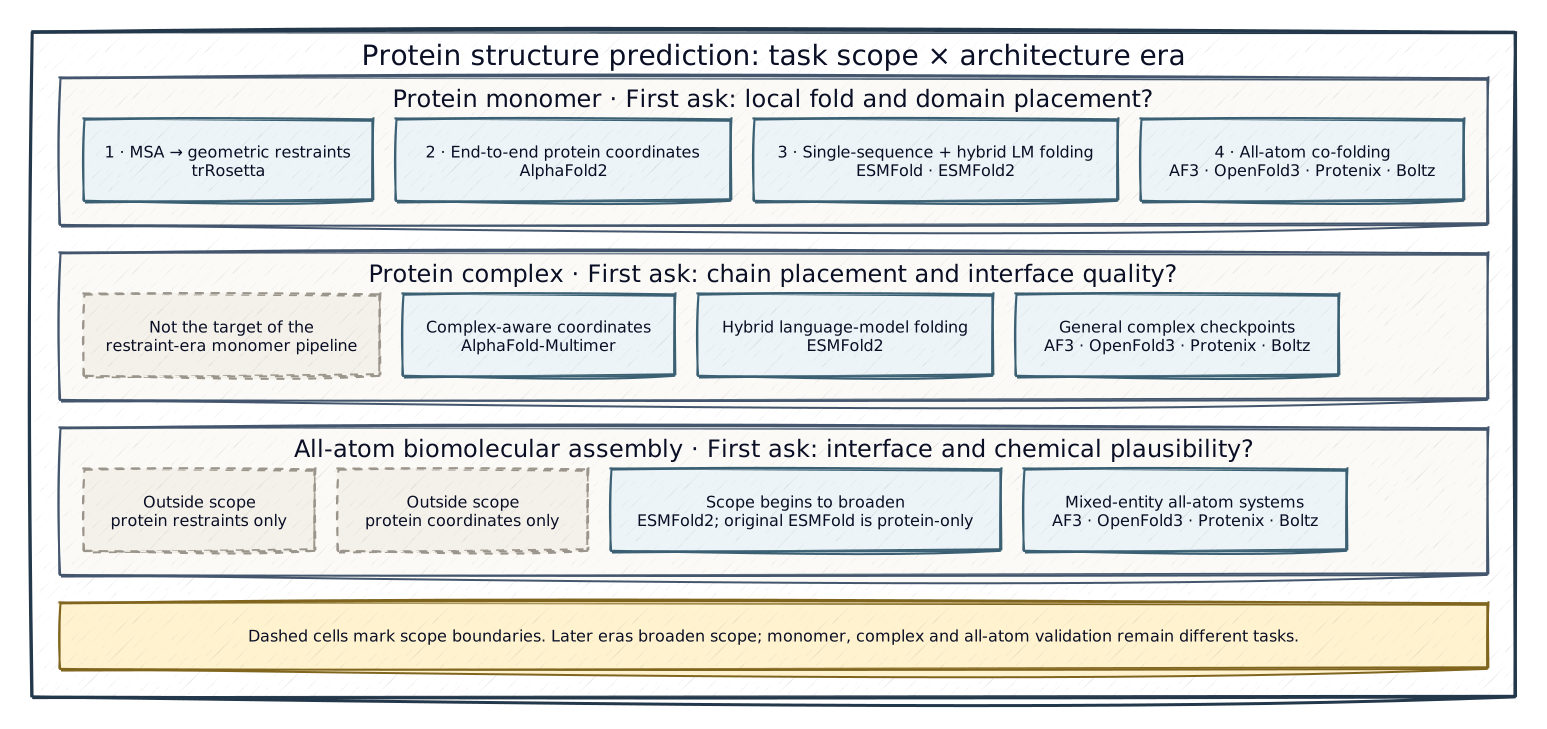
Figure 1. Author-created synthesis of task scope and major architecture eras. Task separation is grounded in FoldBench; the restraint pipeline in Yang et al.; AlphaFold2 in Jumper et al.; original ESMFold in Lin et al.; ESMFold2 in Biohub's model page; AlphaFold3 in Abramson et al.; and later open-system examples in the current OpenFold3, Protenix, and Boltz repositories. The grouping is a decision-oriented synthesis, not a benchmark ranking.
The useful question is therefore not “Which model is best?” It is “Which system ran the right experiment for my object, constraints and claim?”
Era one: an alignment became geometric restraints
trRosetta makes the older division of labour unusually clear. Its neural network consumes a multiple sequence alignment, or MSA, and predicts distributions over residue-pair distances and orientations. A separate Rosetta procedure converts those predictions into restraints and builds coordinates through restrained minimization. (Yang et al., 2020)
The alignment was not neutral plumbing. In one CASP13 example, trRosetta's authors reported that a domain-specific alignment increased TM-score from 0.38 to 0.63. They also warned that later sequence and metagenomic data could make retrospective comparisons with CASP groups look optimistic. Those numbers are specific to their example, but the operational lesson survives: database date, coverage and domain boundaries are part of the run. (Yang et al., 2020)
An MSA-based model can exploit information that is absent from a lone query sequence, but obtaining that input costs search time, databases and a set of pairing decisions for complexes. “MSA-based” is not a complete method description. You need to know which alignment entered the model. (Mirdita et al., 2022)
Era two: AlphaFold made coordinates the direct output
AlphaFold2 retained the primary sequence, an MSA and optional structural templates as inputs. Its decisive change was to emit protein coordinates directly rather than hand learned restraints to a separate construction pipeline. (Jumper et al., 2021)
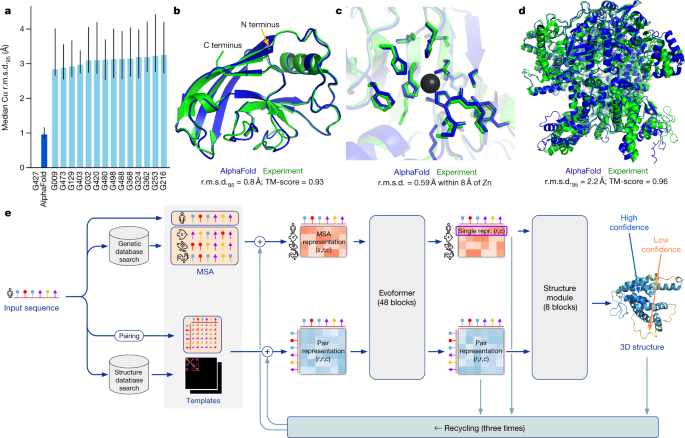
Figure 2. AlphaFold2's published overview connects sequence and structural data, learned coordinate generation and confidence. Source: Jumper, J. et al., “Highly accurate protein structure prediction with AlphaFold,” Nature 596, 583–589 (2021), Fig. 1. Article. Licensed under CC BY 4.0. Unmodified. Performance examples and benchmark panels in the source figure are author-reported under the paper's evaluation protocol.
Direct output did not remove systems work. The AlphaFold2 paper reported inference ranging from GPU minutes to GPU hours depending on sequence length, including roughly one GPU minute per model for 384 residues in one setup. It also reported approximately quadratic memory growth with residue count and used unified memory for a 2,500-residue example on V100-era hardware. These are historical, configuration-specific measurements, not a 2026 shopping guide. They still explain why target length and hardware belong beside every runtime claim. (Jumper et al., 2021)
The AlphaFold lineage then split into products for different constraints. AlphaFold-Multimer addressed protein assemblies. ColabFold reduced the operational cost of obtaining inputs and running AlphaFold2-family predictions. OpenFold addressed reproducibility by supplying a trainable PyTorch reproduction and open training resources. Its developers reported AlphaFold2-level accuracy after training from scratch; its code is Apache 2.0, while released parameters and OpenProteinSet are CC BY 4.0. (Ahdritz et al., 2024; OpenFold repository)
ColabFold is particularly useful because it exposes the pipeline rather than hiding it. Its authors coupled MMseqs2 search with AlphaFold2 or RoseTTAFold. In their tested configuration, they reported 40 to 60-fold faster search and close to 1,000 structures per day on a one-GPU server. It offers hosted use and a local batch path. That throughput is author-reported and workload-specific, but the separation between search, prediction and ranking is durable. (Mirdita et al., 2022)
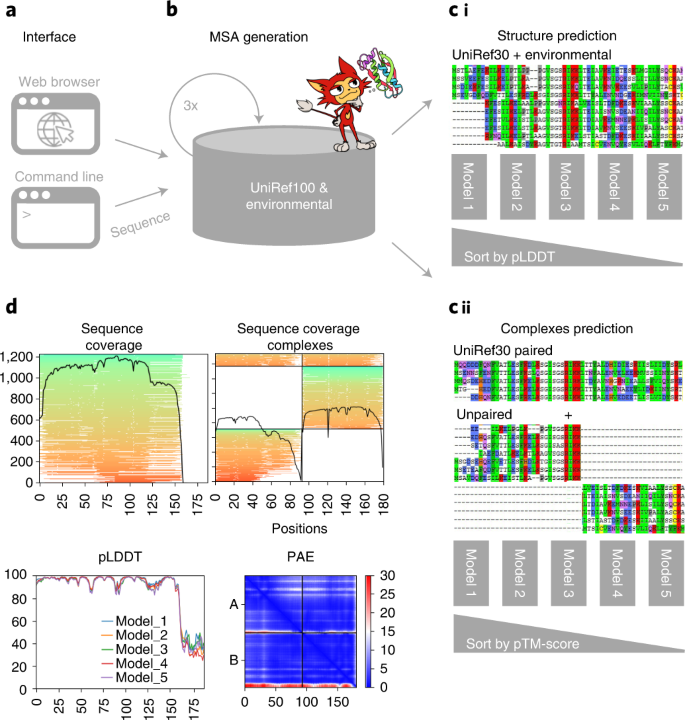
Figure 3. ColabFold makes the surrounding system visible: MSA generation precedes prediction, while monomer and complex paths use different alignment handling and confidence signals. Source: Mirdita, M. et al., “ColabFold: making protein folding accessible to all,” Nature Methods 19, 679–682 (2022), Fig. 1. Article. Licensed under CC BY 4.0. Unmodified. The paper's search-speed and throughput figures are author-reported for its stated hardware and workflow.
For me, this remains the right baseline lesson from AlphaFold2. A mature model is valuable, but the actual product is model plus data pipeline plus confidence interpretation. A PDB file alone does not record any of those conditions.
Era three: single-sequence prediction became a conditioning choice
The original ESMFold demonstrated direct, full atomic protein-structure inference from a primary sequence. Its official model table describes a 690-million-parameter folding component paired with a 3-billion-parameter ESM-2 model. It was an end-to-end, single-sequence protein predictor, not a general co-folding system for ligands, RNA and DNA. The archived repository explicitly licenses the source code under MIT; that sentence should not be stretched into a claim about every historical service or model artifact. (Lin et al., 2023; archived ESM repository)
This route removes a fresh MSA from the inference path. That can simplify high-throughput triage and keep a sequence inside local infrastructure, provided the model itself can be run locally. It also changes the evidence supplied to the run. CASP15's assessors found that the language-model methods entered in that round lagged AlphaFold2-derived approaches, including on shallow-alignment targets where an advantage had been expected. They explicitly cautioned against treating that round as a final verdict on the method family. (CASP15 overview, 2023)
ESMFold2 is a successor, not a routine version bump. Current official material says it combines representations from the 6-billion-parameter ESMC model with looped folding layers and a diffusion model that projects pairwise representations to atomic predictions. The full model can run from one sequence or accept an optional MSA for difficult targets. ESMFold2-Fast is an inference-optimized single-sequence variant and is not MSA-conditioned. (Biohub ESM repository; ESMFold2 model page)
Biohub also gives ESMFold2 a broader target scope. It describes all-atom structures of biomolecular complexes and lists proteins, small molecules, DNA, RNA and modified amino acids. The released ESMFold2 models use the MIT licence. Its developers report leading FoldBench-derived results on protein-protein and antibody-antigen tasks and an order-of-magnitude speed-up in single-sequence mode. Those performance and speed statements are developer-reported; the verified evidence for this article did not contain a matched independent reproduction of the released checkpoints. (Biohub ESM repository; ESMFold2 model page)
Biohub's limitations draw a harder boundary around the output. ESMFold2 predicts one static conformation and is not designed to model dynamics, conformational flexibility or multiple conformations of the same protein. Those limitations mean that repeated diffusion samples should not be interpreted as a thermodynamic ensemble. (ESMFold2 model page)
The old binary of “MSA model versus single-sequence model” is therefore no longer sufficient. One checkpoint family can expose both modes, so the relevant distinction belongs to the named run. Compare named runs: checkpoint, MSA or no MSA, templates, recycles, sample count and ranking rule.
Era four: all-atom diffusion separated generation from selection
AlphaFold3 changed both scope and architecture. It reduced MSA processing, replaced AlphaFold2's Evoformer with a simpler Pairformer, and replaced the amino-acid-specific AlphaFold2 structure module with diffusion that directly predicts raw atom coordinates. Its joint-complex scope includes proteins, nucleic acids, small molecules, ions and modified residues. (Abramson et al., 2024)
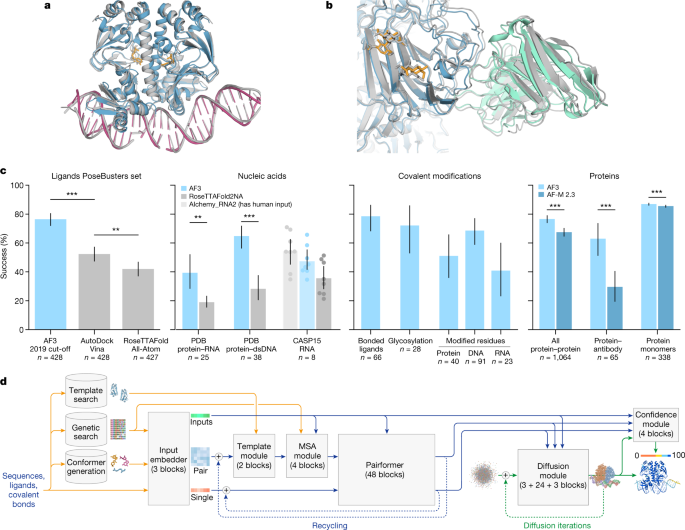
Figure 4. AlphaFold3 broadens the supported entities and replaces AlphaFold2's structure module with an atom-coordinate diffusion process. Source: Abramson, J. et al., “Accurate structure prediction of biomolecular interactions with AlphaFold 3,” Nature 630, 493–500 (2024), Fig. 1. Article. Licensed under CC BY 4.0. Unmodified. All benchmark and comparative-performance panels in the source figure are developer-reported under the paper's protocol.
FoldBench offers an independent counterweight, but only for the five systems and versions it tested: AlphaFold3, Boltz-1, Chai-1, HelixFold3 and Protenix. FoldBench's authors found that AlphaFold3 led across their tested metrics and categories. At task level, the story was less uniform. Its difference from Boltz-1 and Chai-1 on general protein-protein prediction was not statistically significant, while HelixFold3 led protein-peptide prediction with an 89.5 percent success rate. On 172 antibody-antigen pairs, AlphaFold3's success rate at the stated DockQ threshold fell to 47.9 percent, although it led most cutoffs. (Xu et al., 2026)
Those results do not transfer to a later checkpoint or a cheaper run. FoldBench used 25 predictions per target and ten recycles on H800 80 GB GPUs. Its protein-ligand analysis also found higher docking success as ligands became more similar to training-set ligands, which the authors interpreted as limited generalization to unseen ligands. An overall lead is useful orientation. It is not permission to skip task-specific validation. (Xu et al., 2026)
AlphaFold3's access stack illustrates a second limit. Its inference code is Apache 2.0, but its parameters and outputs are governed by separate terms limiting them to qualifying non-commercial use. The official server is also non-commercial and supports fewer ligand and covalent-modification options than local inference. Local operation separates a time-consuming CPU genetic and template pipeline from GPU inference. (AlphaFold3 repository; parameter terms; output terms)
For a commercial local workflow, I would check weight and output terms before comparing accuracy. A benchmark win cannot make an unusable artifact usable.
Compare open alternatives on six constraints
The current open field is real, but “open” is not a sufficient column heading. Use six constraints, in this order.
| Constraint | What to record | Why it changes the result |
|---|---|---|
| Biological scope | Exact supported chains, ligands, ions and modifications | Monomer, interface and mixed-entity claims fail differently |
| Conditioning path | MSA, paired MSA, templates, restraints or single sequence | The input evidence is part of the experiment |
| Sampling budget | Seeds, recycles, loops and diffusion samples | A one-shot run is not comparable with a 25-sample protocol |
| Selection rule | Confidence ranker and number of retained candidates | A generator can produce a useful sample that ranking misses |
| Compute and reproducibility | CPU preprocessing, databases, GPU memory, checkpoint and training access | Runtime claims often count different pipeline stages |
| Rights | Code, weights, training data, service and output terms | A repository licence rarely describes the entire deployment |
The matrix turns “open” into six deployment questions. Each example below exposes a different constraint.
Sampling and selection. OpenFold3's general line remains a preview as of 24 August 2026. Its official repository names OpenFold3-preview2 as the most recent documented general version and says the final OpenFold3 model is still in development. Preview 2's reported benchmark protocol used an MSA subsampled to 1,024 sequences, ten trunk recycles, five MSA seeds and five diffusion samples per seed. Its authors also found that the gap to AlphaFold3 was smaller when an oracle chose with knowledge of ground truth than when the model's confidence ranker chose. Generation and selection were separate bottlenecks. (OpenFold3 repository; Preview 2 report)
Version identity. OpenBind-0, released on 21 August 2026, is a separate protein-small-molecule co-folding series built on OpenFold3. Its release post says it uses a nearly final version of the upcoming OpenFold3 architecture and was trained on PDB data through June 2025. It is not the final general OpenFold3 model. The project states Apache 2.0 coverage for its training data, code, weights and recipes. (OpenBind-0 release)
Inference scaling. Protenix publishes code and parameters under Apache 2.0. Developers describe Protenix-v2 as an expanded model of about 464 million parameters and report 9 to 13 percentage-point gains over v1 at a stated DockQ threshold across three collections. A separate repository claim says that increasing candidate samples from several to hundreds produced log-linear gains on difficult antibody-antigen targets for Protenix-v1. The version label matters: the v1 sampling result is not a v2 result, and FoldBench's independent Protenix row should not be relabelled as validation of v2. (Protenix repository; Protenix-v2 report)
Conditioning and geometric control. RosettaFold3, or RF3, is an all-atom network with implicit chirality representations and atom-level geometric conditioning for tasks including chiral ligands and fixed-backbone or fixed-conformer docking. It accepts optional MSA files, but its current documentation does not generate an MSA on the fly. It can stop a low-confidence run early to save compute.
Foundry's licence permits source and binary redistribution subject to its stated conditions, but that does not license every older RoseTTAFold artifact. The original RoseTTAFold repository, for example, uses MIT for code and separate non-commercial terms for trained weights and data. (RF3 documentation; Foundry licence; RoseTTAFold repository)
Commercial rights and infrastructure. Boltz states that its code and weights are MIT-licensed for academic and commercial use. Chai-1's current repository now states Apache 2.0 for both code and weights, including commercial use, superseding the non-commercial local language in its 2024 report. Chai supports automatic or custom MSAs and templates, and recommends large-memory GPUs for typical workloads.
HelixFold3 takes another route. Its downloadable code and parameters are non-commercial. Its reduced databases occupy about 530 GB uncompressed, and its documentation gives roughly 1,200 tokens on an A100 40 GB in bf16. (Boltz repository; Chai-1 repository; Chai-1 2024 report; HelixFold3 documentation)
There is no honest universal runtime row for these systems under the heterogeneous protocols above. Some reports include MSA search and templates; others begin with prepared features. Sampling and recycle budgets differ. Quote the measured workflow, not “seconds per protein.”
Confidence is a routing signal, not a verdict
For local protein geometry, start with pLDDT. ColabFold's authors explicitly say it is useful only for local confidence. A chain can look locally convincing while the relationship between its domains or partners remains uncertain. (Mirdita et al., 2022)
For domain and chain placement, inspect PAE and topology-oriented scores. For an interface, inspect the between-chain error pattern and ipTM, not only average pLDDT. AlphaFold3 also reports PDE, a predicted distance-error matrix. These are ranking and diagnostic outputs. They do not establish that a biological interaction occurs. (Mirdita et al., 2022; Abramson et al., 2024)
For all-atom work, add an external geometry and chemistry review. A Cα-only accuracy measure does not penalize clashes or other heavy-atom structural violations. (Jumper et al., 2021) Ligand pose, chirality, bond geometry and steric plausibility therefore need separate checks; AlphaFold3's own evaluation reports residual chirality and clash failures. (Abramson et al., 2024)
The OpenFold3 Preview 2 result supplies the final caution: confidence ranking can miss a better generated sample. More sampling buys candidate diversity. It does not guarantee that the ranker will choose well.
A decision procedure you can run before the model

Figure 5. The author's pre-run selection framework. Scope and benchmark caution are grounded in FoldBench; MSA and interface-confidence choices in ColabFold; the OpenFold baseline in Ahdritz et al. and its repository; AlphaFold-Multimer in Evans et al.; original ESMFold in Lin et al. and the archived repository; AF3 in Abramson et al.; and current official sources for AF3, ESMFold2, OpenFold3-preview2, OpenBind-0, Protenix, RF3, Boltz, Chai-1, and HelixFold3. OpenFold3 Preview 2 requires an older compatible package; current package releases default to OpenBind-0. Routes are pragmatic starting points, not comparative-performance claims. Recheck all terms at deployment.
In prose, the procedure is shorter than the diagram looks.
- Specify the object and consequence. A routine monomer annotation, a proposed interface and a ligand pose justify different models and validation budgets.
- Remove unusable artifacts. Check code, weights, service, training data and outputs separately. Apply data-egress policy before calling a public MSA or inference service.
- Establish the cheapest credible baseline. “Credible” means that the checkpoint supports the entities and emits confidence at the level of the claim. It does not mean the newest model.
- Escalate deliberately. Add an MSA, templates, restraints, recycles or diffusion samples when uncertainty and consequence justify their cost. Record each change as a new experiment.
- Test the selection rule. Retain more than the top-ranked candidate when sampling is central. Inspect whether plausible alternatives are being discarded.
- Seek disagreement. A second conditioning strategy can expose uncertainty that repeated seeds from one checkpoint will not. This is a diagnostic heuristic, not independent validation.
- Validate and report. Match local confidence, relative-placement confidence, interface assessment and chemistry checks to the claim. Preserve enough metadata to reproduce the run, and use experiments for consequential biological conclusions.
A FASTA file identifies a sequence. It does not specify an assembly, a ligand state, a data policy, an inference budget or an acceptable failure. Once those are written down, the choice becomes much easier: choose the task first, the artifact second, and the benchmark only after its checkpoint and run protocol match yours.
Part 2 will move upstream from the folding head to protein language models, the representations they supply, and the evidence needed to evaluate them.
References
- Yang, J. et al. “Improved protein structure prediction using predicted interresidue orientations.” PNAS 117, 1496–1503 (2020). https://doi.org/10.1073/pnas.1914677117
- Jumper, J. et al. “Highly accurate protein structure prediction with AlphaFold.” Nature 596, 583–589 (2021). https://doi.org/10.1038/s41586-021-03819-2
- Evans, R. et al. “Protein complex prediction with AlphaFold-Multimer.” bioRxiv (2021). https://doi.org/10.1101/2021.10.04.463034
- Mirdita, M. et al. “ColabFold: making protein folding accessible to all.” Nature Methods 19, 679–682 (2022). https://doi.org/10.1038/s41592-022-01488-1
- Lin, Z. et al. “Evolutionary-scale prediction of atomic-level protein structure with a language model.” Science 379, 1123–1130 (2023). https://pubmed.ncbi.nlm.nih.gov/36927031/
- Ahdritz, G., Bouatta, N. et al. “OpenFold: retraining AlphaFold2 yields new insights into its learning mechanisms and capacity for generalization.” Nature Methods 21, 1514–1524 (2024). https://doi.org/10.1038/s41592-024-02272-z
- Abramson, J. et al. “Accurate structure prediction of biomolecular interactions with AlphaFold 3.” Nature 630, 493–500 (2024). https://doi.org/10.1038/s41586-024-07487-w
- Chakravarty, D. et al. “AlphaFold predictions of fold-switched conformations are driven by structure memorization.” Nature Communications 15, 7296 (2024). https://doi.org/10.1038/s41467-024-51801-z
- Kryshtafovych, A. et al. “Critical Assessment of Methods of Protein Structure Prediction (CASP), Round XV.” Proteins 91, 1539–1549 (2023). https://doi.org/10.1002/prot.26617
- Xu, S. et al. “Benchmarking all-atom biomolecular structure prediction with FoldBench.” Nature Communications 17, 442 (2026; published online 2025). https://doi.org/10.1038/s41467-025-67127-3
- Google DeepMind. “AlphaFold 3 official repository, model parameter terms, and output terms.” Repository; parameter terms; output terms
- Meta AI. “ESM archived repository at commit 2b36991.” https://github.com/facebookresearch/esm/blob/2b369911bb5b4b0dda914521b9475cad1656b2ac/README.md
- Biohub. “ESM repository and ESMFold2 model page.” Repository; model page
- OpenFold Consortium. “OpenFold and OpenFold3 repositories.” OpenFold; OpenFold3
- OpenFold3 Team. “OpenFold3 Preview 2 Technical Report.” (2026). https://portal.openfold.omsf.io/reports/of3p2_technical_report.pdf
- OpenBind. “OpenBind-0: Advancing Open Molecular Structure Prediction.” (21 August 2026). https://openbind.uk/news/blog-openbind-0-advancing-open-molecular-structure-prediction/
- ByteDance Research. “Protenix official repository.” https://github.com/bytedance/Protenix
- Zhang, Y. et al. “Protenix-v2: Broadening the Reach of Structure Prediction and Biomolecular Design.” bioRxiv (2026). https://doi.org/10.64898/2026.04.10.717613
- RosettaCommons. “RosettaFold3 inference documentation and Foundry licence.” Documentation; licence
- RosettaCommons. “RoseTTAFold official repository.” https://github.com/RosettaCommons/RoseTTAFold
- Wohlwend, J. et al. “Boltz official repository.” https://github.com/jwohlwend/boltz
- Chai Discovery. “Chai-1 official repository and 2024 technical report.” Repository; report
- PaddleHelix. “HelixFold3 official documentation.” https://github.com/PaddlePaddle/PaddleHelix/tree/dev/apps/protein_folding/helixfold3
Comments and feedback
Spotted an error or have a counterpoint? Comment below. No account needed, a name is enough. Corrections and pushback are welcome.