An RNA Sequence Is Not a Molecular State: RNA Foundation Models in 2026
Part 5, A DNA Likelihood Is Not a Functional Assay, stopped at a biological boundary. A reference DNA window does not specify which transcript exists, which splice form survives, how efficiently it is translated, or what molecular state the RNA occupies.
Then the next ticket arrives:
We have a 120-nucleotide RNA. Pick the best foundation model. Return its function, its structure, and an improved sequence.
The request sounds compact because all three outputs can be represented on a computer. Biologically, it is several different experiments hiding in one sentence. Is the input genomic pre-mRNA or a mature transcript? Does “structure” mean a base-pair matrix, one atomic conformation, or an ensemble? Does “improved” mean higher masked-token likelihood, preservation of a target fold, brighter aptamer fluorescence, or more protein in one reporter assay?
The models in this article share A, C, G, and U. They do not share an estimand, the quantity we intend to estimate.
That distinction is the useful way to read the RNA field in 2026. RNA-FM, RiNALMo, and Uni-RNA learn sequence representations. SpliceBERT is aimed at primary-transcript context. UTR-LM specialises in 5′-UTR regulation. RhoFold+, NuFold, DRfold2, and RNAPro predict 3D coordinates under different information regimes. Design systems reverse one of those mappings, then face an assay. Their scores cannot be poured into one leaderboard without changing the question.
Compile the biological request before loading a checkpoint
An executable request needs six fields: the biological object, model input, output, adaptation regime, evaluation split, and evidence threshold. The first diagram is a routing map, not a ranking.
Figure 1. Editorial synthesis of the six task contracts. System placements and evidence gates are derived from the primary records for RNA-FM, RiNALMo, Uni-RNA, SpliceBERT, UTR-LM, Archive-NoFam, RhoFold+, NuFold, DRfold2, RNAPro, RiboDiffusion, and RhoDesign. The stop nodes are editorial acceptance rules, not reported model results.
The fast routing guide is therefore short:
| Intended task | Required output and honest evidence | Representative starting point | Stop when |
|---|---|---|---|
| Sequence representation | Untouched logits, frozen embeddings, a trained probe, or fine-tuning, named separately | RNA-FM, RiNALMo, Uni-RNA | The requested quantity is a biological endpoint the representation never measures |
| Local splicing | Nucleotide or window labels on pre-mRNA; author-reported retrospective evaluation | SpliceBERT | The requirement is tissue-specific isoform abundance or a whole-transcript outcome |
| Translation or 5′-UTR regulation | An assay-defined endpoint such as mean ribosome load (MRL), translation efficiency, or protein output | UTR-LM plus an assay-specific baseline | Training and deployment constructs, cells, or endpoints do not match |
| Secondary structure | Base-pair probabilities or dot-bracket under a declared pairing and pseudoknot policy | A structure head plus thermodynamic and covariation baselines, tested on family-disjoint data | The claim requires atomic geometry, an ensemble, or function |
| Tertiary structure | Coordinates, ranking, and confidence under declared multiple sequence alignment (MSA) and template regimes | RhoFold+, NuFold, DRfold2, or RNAPro | Retrieval is unavailable, the target is unsupported, or confidence does not justify a model |
| Design | Candidate sequences followed by a complete prospective assay funnel | RiboDiffusion, RhoDesign, or a task-specific optimiser | There is no assay for the claimed improvement |
I use five evidence labels throughout. Author-reported retrospective means developers score after labels or structures exist. Temporal holdout means targets post-date a documented cutoff, but evaluation still happens after release. Independent blind means an outside organiser receives and freezes predictions while the experimental target structure or outcome remains undisclosed. Prospective, author-run wet-lab means the originating team selects candidates and assays them later. An artifact claim concerns current code, model, data, or licence availability, not biological validity.
In the primary sources reviewed through 2026-09-01, I found independent blind evidence for RNA structure prediction and a few author-run prospective assays. I found no independent prospective replication for the nine representative systems. That empty rung matters more than another decimal place on a developer benchmark.
An encoder supplies representations, not biological labels
A masked language model learns to recover hidden nucleotides from context. Its logits measure compatibility with the learned sequence distribution. Its hidden states provide a vector for each nucleotide or sequence. Neither output arrives labelled “splice defect,” “stable fold,” or “high translation.”
There are four different experiments that often get called zero-shot. Directly scoring untouched logits is one. Extracting frozen embeddings without labels is another. Training a linear probe on those embeddings introduces supervision. Fine-tuning the encoder introduces more. A frozen backbone with a trained classifier is supervised transfer, not zero-shot biology.
The three general encoders illustrate why corpus headlines also need a contract.
RNA-FM remains a useful public representation baseline, but its primary paper is an arXiv preprint. The reported pretraining pool contained roughly 27 million non-coding RNA records from 47 databases. Exact deduplication at 100 percent identity left 23.7 million sequences. The paper reports 12 transformer layers and 640-dimensional states; the official repository tabulates about 99 million parameters (Chen et al., arXiv v5). Exact deduplication removes identical strings; it does not create a family-, fold-, or function-disjoint evaluation.
RiNALMo is peer-reviewed and much larger: 650 million parameters. Its authors report 36 million unique non-coding RNA sequences clustered into 17 million groups after length filtering, deduplication, and 70 percent identity clustering with an 80 percent coverage setting. Training crops inputs to 1,024 tokens (Penić et al., 2025). It is also the cleanest artifact case among the encoders: the official project separates Apache-2.0 code from CC BY 4.0 model parameters and archives 35M, 150M, and 650M checkpoints on Zenodo (repository and licence statement, weights).
Uni-RNA is a more cautionary scale claim. The 2023 unreviewed preprint describes a candidate database of about one billion aggregated RNA records, but its own architecture table says L8 and L12 trained on 100 million sequences, while L16 and L24 trained on 500 million. The current official repository, inspected on 2026-09-01, releases L8, L12, and L16, not the evaluated L24 or the corpus. The repository is CC BY-NC 4.0; the inspected record did not separately establish terms for the externally hosted checkpoints (Wang et al., bioRxiv v1, official repository). Aggregate pool size, per-model exposure, review status, and runnable release are four different facts.
Broad benchmark suites do not erase that task dependence. In BEACON's author-reported retrospective evaluation of 13 tasks, the authors found ResNet and LSTM baselines ahead of language models on several tasks (Ren et al., NeurIPS 2024). An independent peer-reviewed retrospective study reran 11 genomic language models across four RNA processes and reported no universal winner; it also warned about reporter-system mismatch and possible pretraining leakage (You et al., 2025). A simple baseline winning is a result, not an embarrassment.
Splicing begins with pre-mRNA, not a generic RNA string
Splicing models operate before a mature transcript is formed. Splice-site and branch-point predictions are local outputs; isoform-level abundance is a different target (Chen et al., 2024).
SpliceBERT makes the boundary visible. The peer-reviewed model has six transformer layers, 512 hidden dimensions, 16 attention heads, about 19.4 million parameters, and a maximum input length of 1,024 tokens. Its authors assembled primary RNA sequences from 72 vertebrates, more than two million sequences covering about 65 billion nucleotides, then used the learned nucleotide embeddings in downstream splicing applications (Chen et al., 2024). The repository warns that sequences below 64 nucleotides fall outside its trained range (official repository).
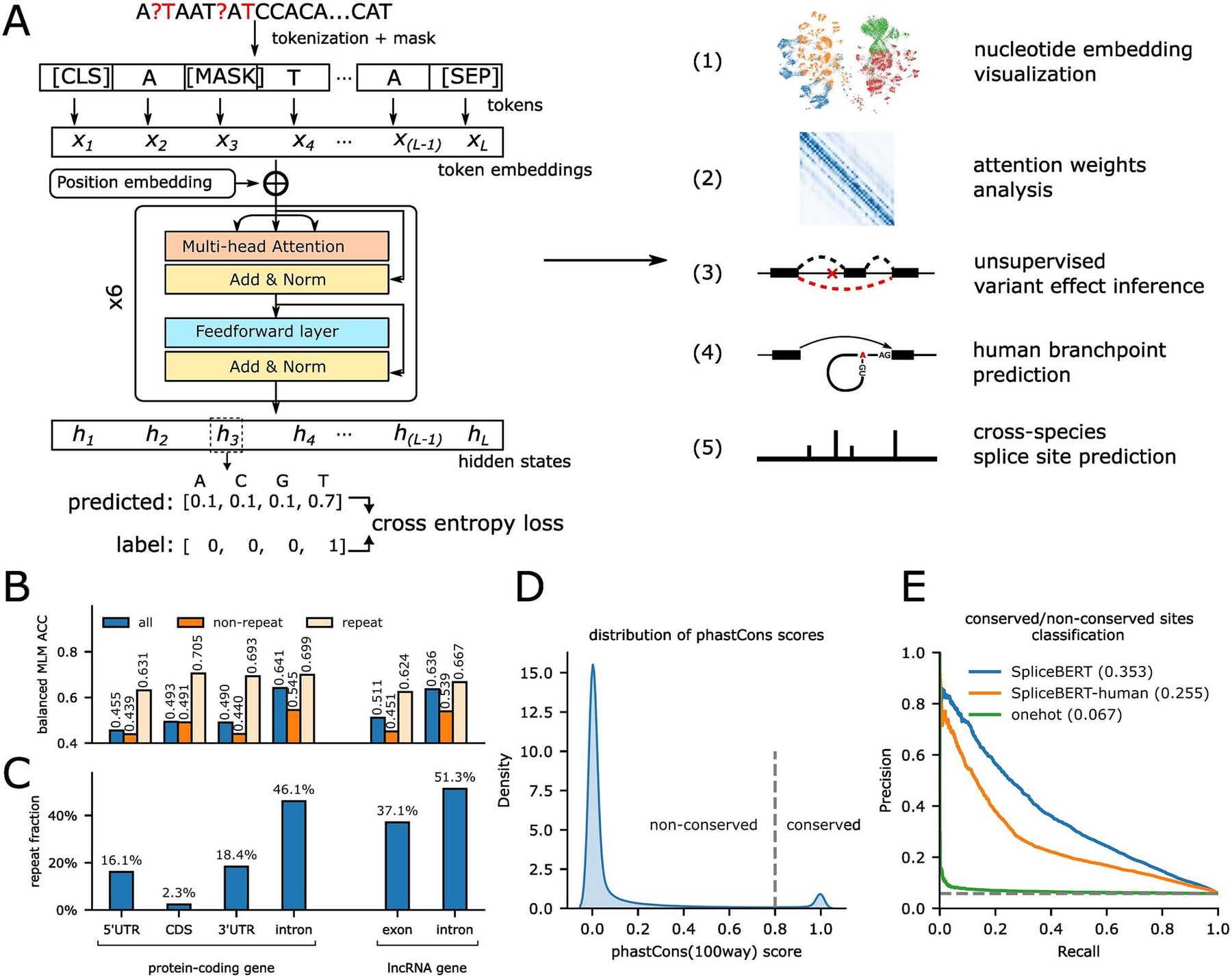
Figure 2. SpliceBERT separates masked-language pretraining from the supervised applications that follow it. Quantitative panels are author-reported retrospective results. Figure 1 from Chen, Zhou, Ding, Wang, Ren and Yang (2024), source, licensed under CC BY 4.0. Extracted at 2000 × 1586 px and proportionally resized to 1800 × 1427 px; no panel removal.
The arrows after the encoder change the claim. The language model emits embeddings; labelled examples turn them into task predictions. If deployment asks whether a variant changes isoform abundance in a tissue, a local-window retrospective benchmark has not answered it. The next experiment needs locus-aware or transcript-aware inputs, biological splits, and a matched assay.
Translation starts from another object and another assay
Mean ribosome load, translation efficiency, RNA expression, internal ribosome entry site (IRES) activity, half-life, and measured protein output are related, but they are not synonyms. Each depends on how the construct and assay define the target. A model trained to estimate one cannot inherit the others through vocabulary (Chu et al., 2024; Shi et al., bioRxiv v1).
The unreviewed mRNABench preprint is useful here as a taxonomy, not as an authority that merges the tasks. Its authors curate ten datasets and 59 prediction tasks, then use linear probes across 45 self-supervised models. Their author-reported retrospective analysis also reports performance inflation from homology leakage (Shi et al., bioRxiv v1).
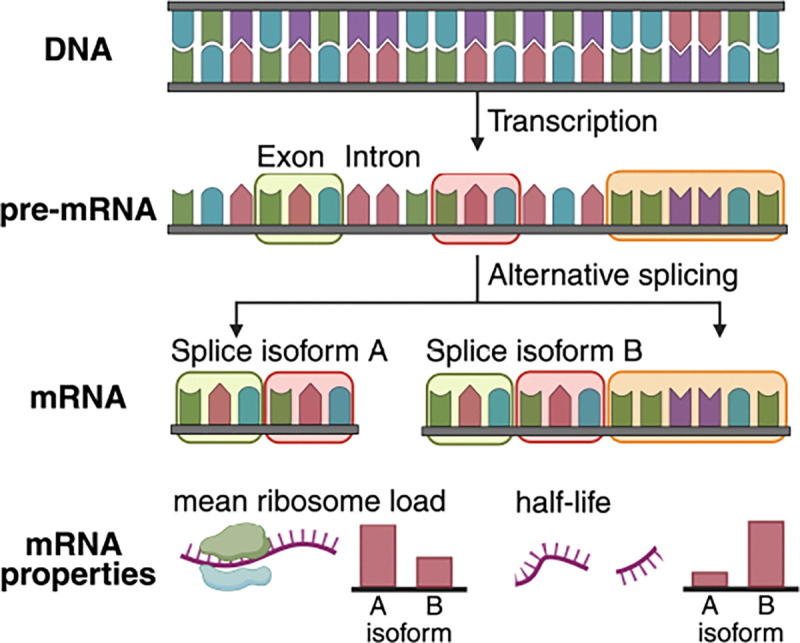
Figure 3. mRNABench maps pre-mRNA processing, alternative isoforms, mean ribosome load, and half-life as distinct targets. It is used here as an unreviewed preprint task map, not performance validation. Figure 1 from Shi et al. (2025), source, licensed under CC BY 4.0. PMC JPEG converted to PNG; no resize or panel selection.
UTR-LM is correspondingly narrow. The peer-reviewed six-layer, 16-head encoder was pretrained with 214,349 endogenous 5′ UTRs from five species plus synthetic libraries. Its pretraining combined masked-nucleotide recovery with computed secondary-structure and minimum-free-energy targets generated by ViennaRNA, then its downstream claims came from fully fine-tuned supervised predictors (Chu et al., 2024). Computed structure is auxiliary supervision, not an experimental measurement of molecular state.
The paper also contains a rarer result. The authors selected and assayed a library of 211 novel 5′ UTRs; the best assayed sequence produced 32.5 percent more protein than NCA-7d-5′UTR in their C2C12 luciferase assay. The proper label is prospective, author-run wet-lab. It validates that selection procedure in that assay, not general expression control, therapeutic performance, or independent replication (Chu et al., 2024).
Scale changes how that denominator feels. In an earlier prospective, author-run wet-lab study, researchers trained a task-specific model on measurements from a randomised library of 280,000 5′ UTRs. They later synthesised 12,000 designed sequences and tested them by polysome profiling (Sample et al., 2019). That is not evidence for a current foundation model. It is evidence that assay design and sample count can matter more than the model category.
A base-pair target stops before atomic geometry
Secondary-structure prediction usually returns a base-pair matrix, pairing probabilities, or dot-bracket notation. An evaluation must declare which pair types count, how pseudoknots are encoded, whether non-canonical contacts are omitted, and which reference annotation supplies the label. It measures agreement with that chosen annotation, not atomic geometry.
Family overlap is the sharper benchmark problem. Closely related sequences can survive exact deduplication, so a random held-out sequence may test recognition of a familiar family rather than generalisation to a new fold family. RiNALMo releases a secondary-structure head, but the decision rule should be independent of the model's name: use a family- or homology-disjoint test and compare with thermodynamic and covariation methods (RiNALMo repository, rMSA).
Archive-NoFam supplies the uncomfortable control. In a 2026 peer-reviewed analysis, the authors assembled RNAs outside the evaluated deep-learning training families and reported that the tested deep-learning methods did not generalise better than thermodynamic methods. That is author-reported retrospective benchmark evidence, bounded to those methods and data (Szikszai et al., 2026). The same paper notes that known family alignments vary from deep, experimentally supported resources to shallow alignments with predicted consensus structures.
The stop condition is literal. A good pair matrix is not an atomic 3D fold. Neither one is a functional assay.
In 3D prediction, query-time information is part of the model
RNA structural data are small and repetitive by protein standards. RNA3DB found 21,005 RNA chains in its January 2024 Protein Data Bank (PDB) snapshot; filtering left 11,176. At 99 percent sequence identity, those chains formed 1,645 clusters, with a median cluster size of two and a 629-chain ribosomal cluster. In the same filtering context, the authors reported nearly 70 times more protein than RNA chains (Szikszai et al., 2024).
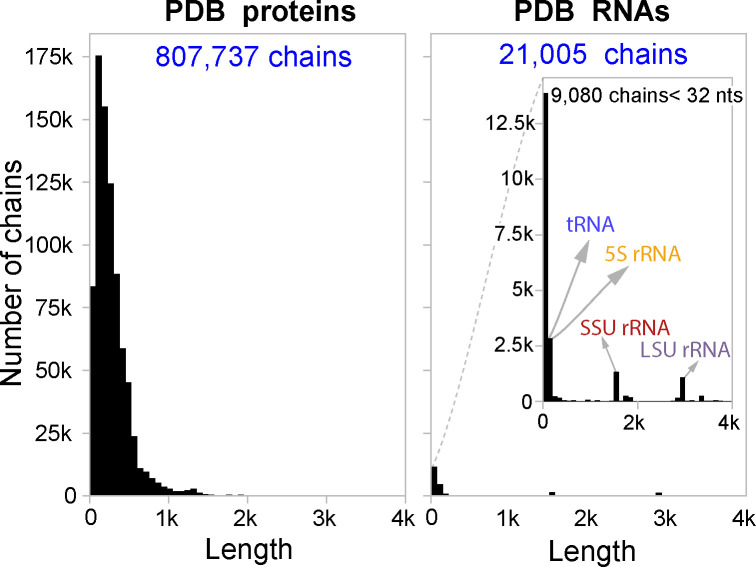
Figure 4. RNA3DB makes the protein-to-RNA structural-data imbalance visible. The counts are the authors' dated PDB analysis, not live database totals. Figure 1 from Szikszai et al. (RNA3DB), exact preprint figure source, licensed under CC BY 4.0. PMC JPEG converted to PNG; no resize or panel selection.
That scarcity makes retrieval, pseudo-labels, and structural overlap unusually consequential. Here, CASP denotes the Critical Assessment of Structure Prediction. “Input: sequence” is too vague for the four representative pipelines:
| System | Query-time information | Training or exposure facts | Evaluation contract |
|---|---|---|---|
| RhoFold+ | Sequence, RNA-FM features, and normally an MSA; no explicit 3D template in the main path | BGSU 2022-04-13 snapshot; 5,583 chains in 782 80%-identity clusters; pseudo-structure augmentation | Author-reported retrospective RNA-Puzzles and CASP15; MSA was the most important ablated component |
| NuFold | Sequence, rMSA, and predicted secondary structure; no explicit 3D template in the main path | PDB cutoff 2022-02-28; 2,860 train, 48 validation, 36 main test chains; 11,101 predicted self-distillation structures | Temporal holdout plus author-reported retrospective CASP15 rerun; “would have ranked,” not a blind submission |
| DRfold2 | A single query sequence, with no query-time MSA or template database | 47.5M-parameter RCLM pretrained on about 30M RNAcentral Release 22 sequences | Author-reported retrospective 41-target set; only nine targets were below 50% identity to training |
| RNAPro | Sequence, MSA, language-model features, and explicit template evidence | Postcompetition synthesis of Kaggle strategies; public/private checkpoints released separately | Competition was blind, but RNAPro's rerun was author-reported retrospective; 19 of 20 analysed competition targets had a potential template in the authors' audit |
MSA-assisted is not template-assisted, but retrieval still changes the task
RhoFold+ and NuFold do not take an explicit 3D template in their main paths. That does not make them single-sequence systems. RhoFold+ normally constructs an MSA from RNAcentral, Rfam, and nt; its repository estimates about 900 GB of local databases and warns that sequence-only mode is less accurate (official repository). NuFold's rMSA setup may require about 2 TB, and its training batches used a 1:3 ratio of experimental to predicted structures (official repository).
An MSA can carry evolutionary constraints that a lone query cannot supply. It can also fail precisely on the understudied target where novelty matters. rMSA's authors explain why curated Rfam alignments are unusually clean: human curation, well-studied families, and trimmed termini. They warn that such benchmarks may not generalise to a poorly studied query (Zhang, Zhang and Pyle, 2023). Database release, search program, depth, runtime, and failure rate therefore belong beside model weights in a benchmark.
Single-sequence input does not mean exposure-free inference
DRfold2 is the useful contrast because its external input is a single sequence. Its pipeline still includes a pretrained composite language model, geometry prediction, denoising, sampling, selection, and refinement. The official installation process downloads about 1.3 GB of weights (DRfold2 repository).
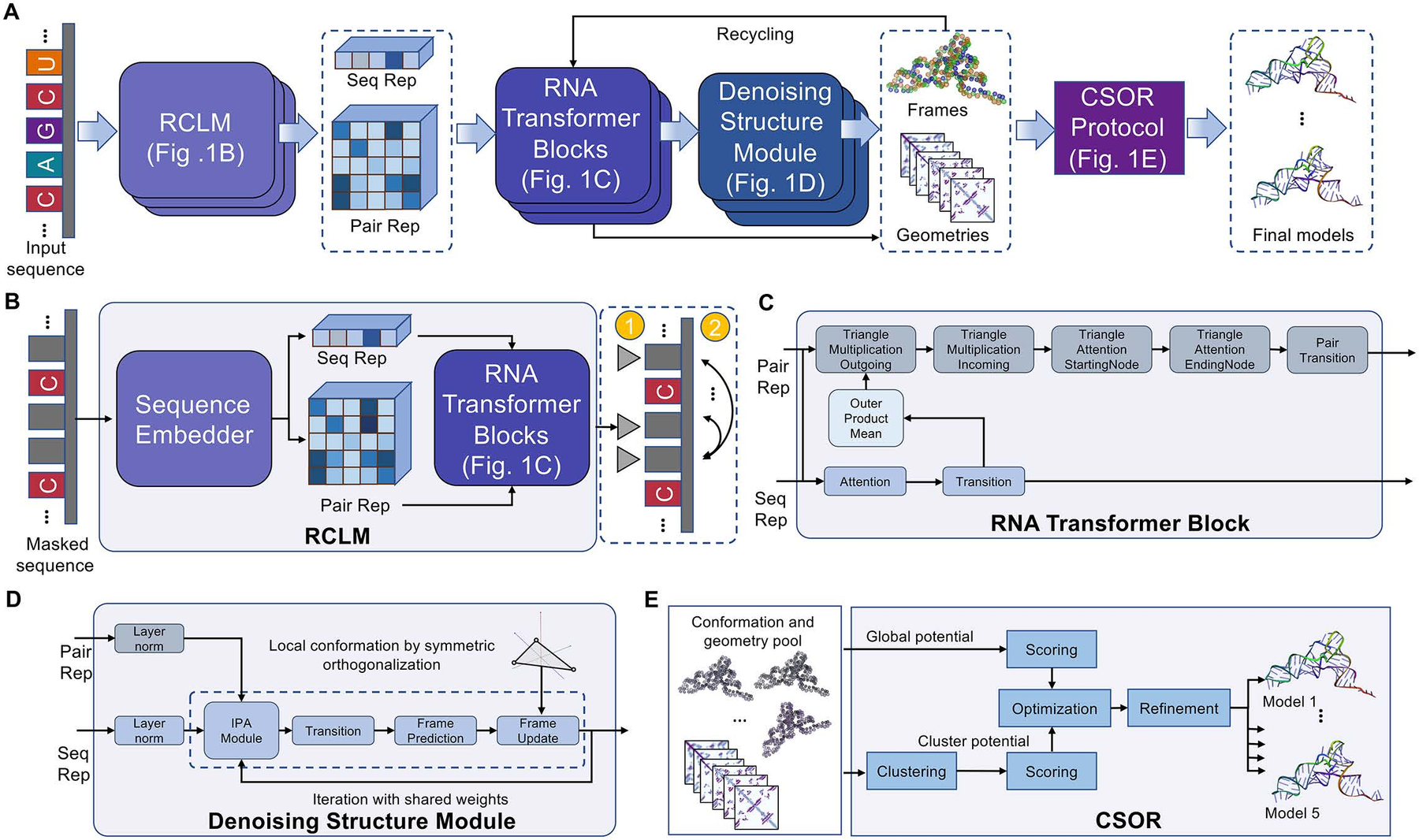
Figure 5. DRfold2 illustrates why a 3D system is more than its encoder: geometry generation, sampling, ranking, and refinement remain separate error sources. Figure 1 from Li et al. (2026), source, licensed under CC BY 4.0. Extracted at 2283 × 1352 px and proportionally resized to 1800 × 1066 px; no panel removal.
The final DRfold2 paper calls its 41-target collection an “independent test dataset,” but it was assembled and evaluated by the developers after structures were available. Treat it as an author-built retrospective holdout, not independent validation. The independently blind CASP16 evidence associated with this line of work belongs to the earlier dNAfold precursor, not automatically to the final DRfold2 system.
A blind competition label does not transfer to a later model
The Stanford RNA 3D Folding Kaggle competition involved more than 1,700 teams and 43 previously unreleased structures. That competition supplied blind targets to submitted algorithms. RNAPro was assembled afterwards, combining template modelling, MSA, a pretrained RNA model, and competition strategies, then reran competition targets retrospectively (Lee et al., bioRxiv v1). RNAPro did not win Kaggle, and the competition's blind label does not travel forward in time.
The same preprint reports potential templates for 19 of 20 analysed competition targets under its threshold. That denominator covers analysed competition targets, not “19 of 20 private targets,” and the audit is author-reported. The authors explicitly warn that conclusions from this template-rich set may not generalise to template-poor RNAs. Public and private leaderboard checkpoints are separately named in the repository; those labels describe competition data partitions, not public versus private reuse rights. Reproducing the template path also involves competition notebooks and external inputs whose terms must be checked separately from the model licence (RNAPro repository).
Blind assessment sets the ceiling for 3D claims
CASP15 and CASP16 are the strongest available reality checks because outside organisers collected predictions before the corresponding experimental structures were released. They assess systems under shared blind conditions, while also exposing how much target class and human intervention matter.
CASP15 received models from 42 groups for 12 RNA-containing targets. The top four groups did not use deep learning; the leading servers placed eighth and ninth. The assessors also noted that many targets showed conformational flexibility, while the exercise scored single structures and did not evaluate full ensembles (Das et al., 2023). This is independent blind evidence.
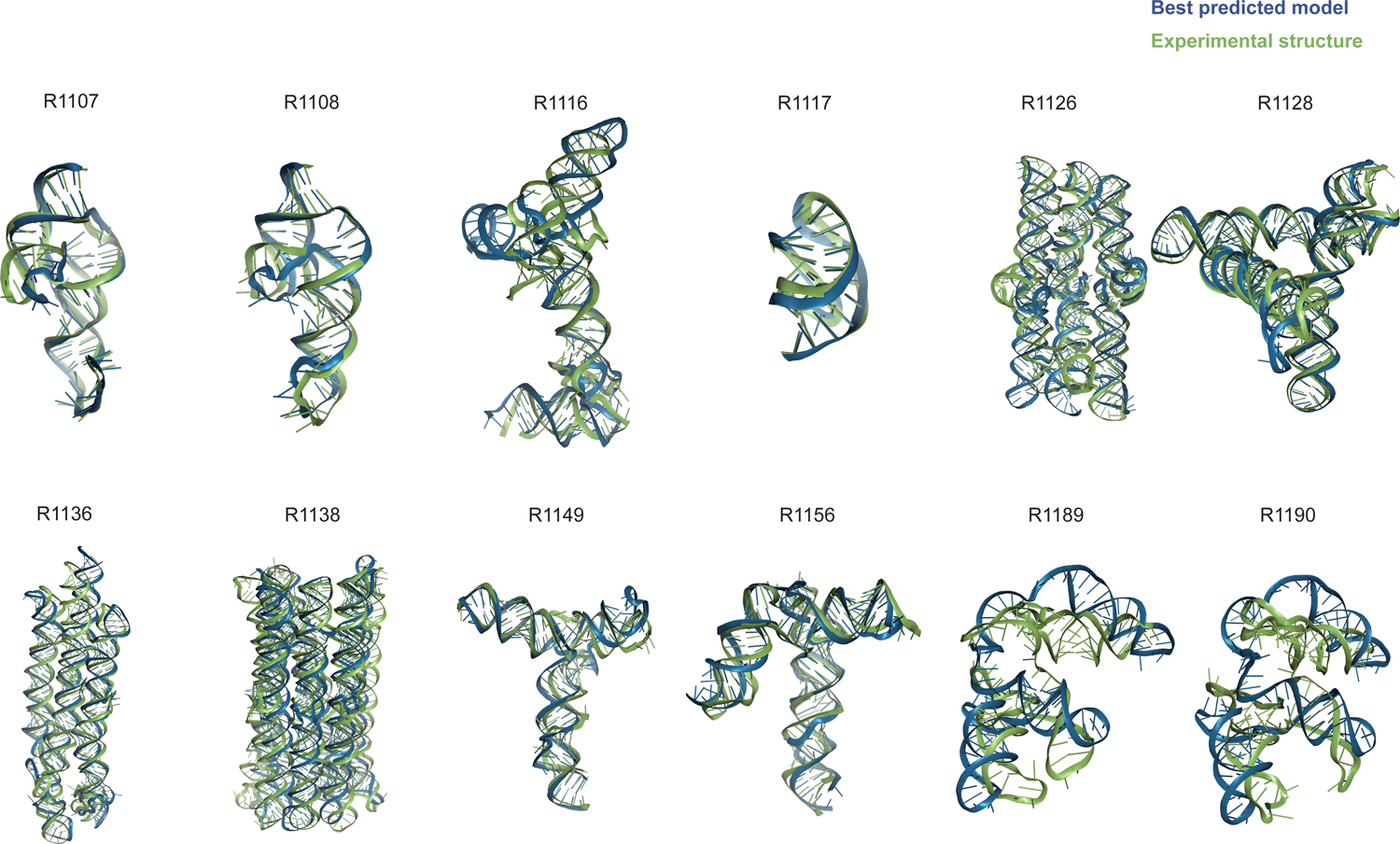
Figure 6. CASP15 target-by-target overlays show why one aggregate score hides large variation across blind RNA targets. Figure 1 from Das et al. (CASP15 RNA assessment), source, licensed under CC BY 4.0. PMC JPEG converted to PNG; no resize or panel selection.
CASP16 drew 65 groups from 46 laboratories across 42 nucleic-acid targets. Its peer-reviewed assessors reported that no prediction of a previously unseen natural RNA exceeded 0.8 on TM-score, a measure of global structural similarity. They also found that the top groups were human experts and that 3D accuracy remained strongly dependent on closely related structures. Complex prediction was generally poor without templates (Kretsch et al., 2026). This is also independent blind evidence.
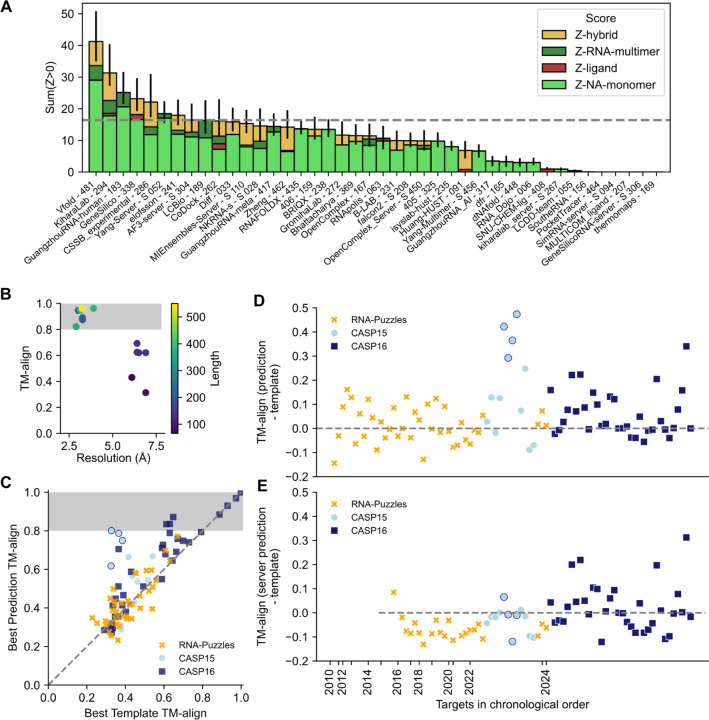
Figure 7. CASP16 places rankings beside template availability, chronology, and comparisons among independently solved structures of the same RNA. Those experimental pairs provide an empirical accuracy ceiling; they were not selected to prove distinct conformational states. Figure 7 from Kretsch et al. (2025), exact preprint figure source, licensed under CC BY 4.0. PMC JPEG converted to PNG; no resize or panel selection.
A separate peer-reviewed retrospective benchmark of five deep-learning and two fragment-assembly methods reached a compatible conclusion: performance depended on MSA depth, RNA type, and secondary-structure quality (Bahai et al., 2024). Per-target reporting should therefore include novelty, template availability and date, MSA depth, target length and type, complex status, best-of-sample versus rank-one accuracy, and whether confidence selected the useful model. Pooled root-mean-square deviation (RMSD) or TM-score alone cannot carry that burden.
A designed sequence enters an assay funnel
Design reverses a mapping, but “design” still names several tasks. Inverse folding asks for sequences compatible with a target secondary or tertiary structure. Structure-conditioned generation samples candidates from a structural constraint. Functional design asks whether a sequence performs in a declared assay. Recovery of a known sequence and predicted fold preservation are computational metrics, not function.
RiboDiffusion is a peer-reviewed 2024 model for fixed-3D-backbone inverse folding. Its authors report sequence- and structure-similarity splits, predicted-structure augmentation, recovery metrics, and in silico folding. The proper label is author-reported retrospective computational evidence; the cited work does not contain a prospective wet-lab assay (Huang et al., 2024).
RhoDesign crosses one more boundary. It was trained with experimental and RhoFold-predicted structures, and its authors then synthesised 18 generated aptamers. Four exceeded the declared activity threshold of at least half the fluorescence brightness of Mango-I. Twenty of 22 RaptGen designs were active but had maximum sequence similarity above 0.7 to known Mango aptamers; the active RhoDesign sequences reached at most 0.59 (Wong et al., 2024). This is prospective, author-run wet-lab evidence, narrow to that aptamer assay. The denominator of 18, including 14 failures, is part of the result.
A separate peer-reviewed study used RNA language models to select ribosomal RNA mutations, built mutant 50S subunits, heat-treated them, and measured in vitro translation. The authors report stabilising changes in four of six mutation groups tested in that study, alongside cases that did not improve on wild type (Shulgina et al., 2024). Again, the label is prospective, author-run wet-lab, not independent replication.
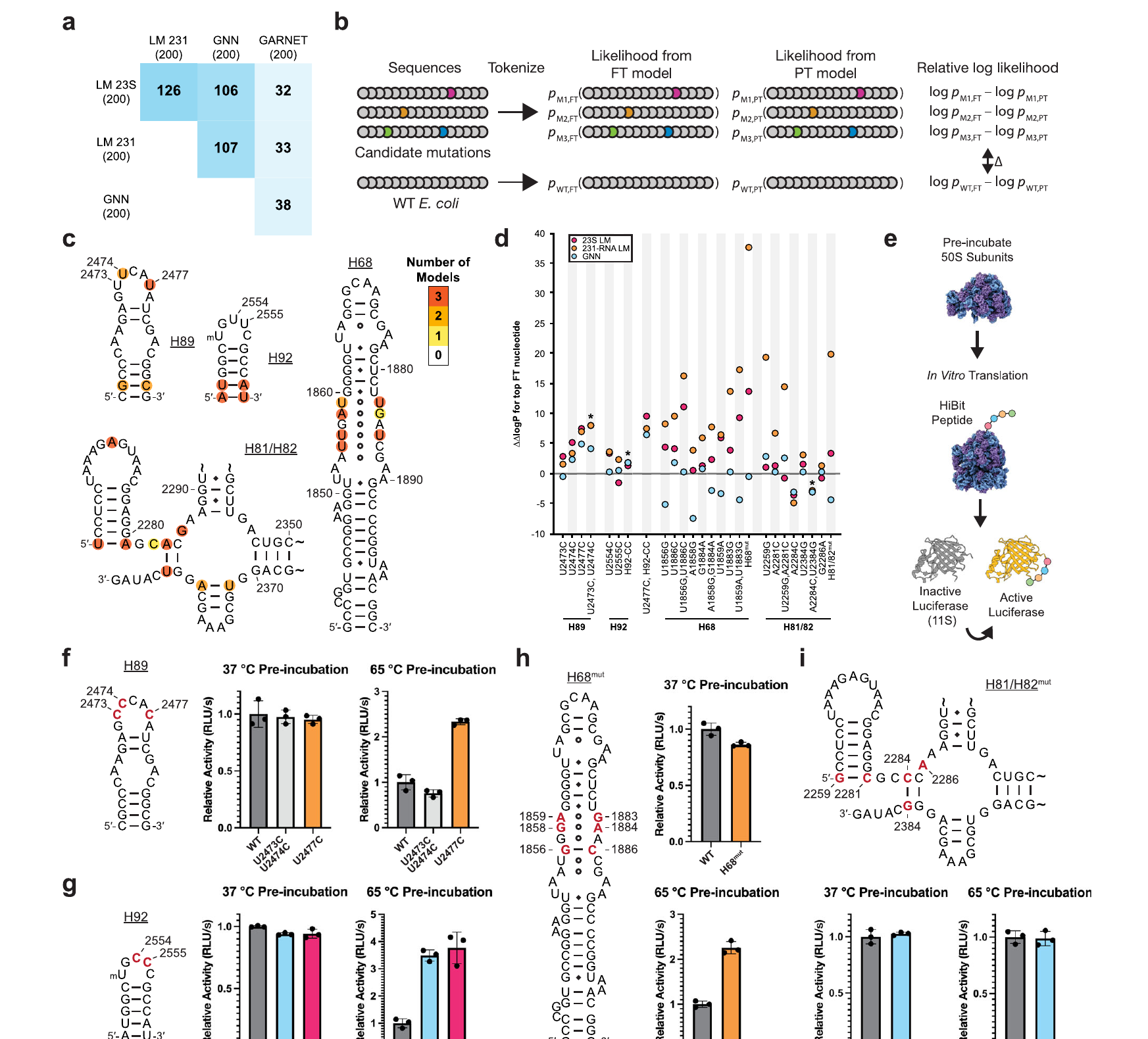
Figure 8. A rare model-to-assay path: language-model-scored mutations were selected before author-run measurements, with positive and negative outcomes retained. Figure 6 from Shulgina et al. (2024), source, licensed under CC BY 4.0. Rendered from PDF at 240 dpi and cropped only to remove article header, caption, and surrounding page text; all scientific panels a–i retained; no internal resize.
The assay, not the model family, determines what crossed into evidence. A credible release should preserve the full funnel: generated, valid, unique, selected, synthesised, successfully assayed, successful, and failed. If a paper reports only recovery among generated sequences or only the best wet-lab example, the missing denominators are the result readers need most.
Downloadable is not the same as deployable or licensed
The artifact audit changed my view more than another benchmark table would have. Code licences were usually easier to find than terms for adjacent checkpoints, data, or services. A repository can be public while a weight licence is absent, narrower, or separately conditioned.
This is the artifact state established by the verified primary records on 2026-09-01. “Not separately established” means exactly that for the inspected artifact; it is not a claim that no terms exist anywhere.
| System | Dated artifact and licence finding |
|---|---|
| RNA-FM | Repository and checkpoint documentation are public; the verified record did not establish a separate, explicit licence for the original checkpoint. |
| RiNALMo | Repository code is Apache-2.0; parameters are explicitly licensed under CC BY 4.0; base and task weights are archived on Zenodo. |
| Uni-RNA | The current official repository is CC BY-NC 4.0 and releases L8, L12, and L16, but not L24 or the pretraining corpus. Commercial use of covered repository material is not permitted; terms for the externally hosted checkpoints were not separately established in the inspected record. |
| SpliceBERT | Official repository code is BSD-3-Clause and links to weights and data on Zenodo; do not transfer the code licence to those artifacts without checking their own record. |
| UTR-LM | Repository code uses GPL-3.0 and links a Code Ocean capsule plus data paths; the code licence does not automatically cover every checkpoint or dataset. |
| RhoFold+ | Repository code carries Apache-2.0; query MSA construction may require about 900 GB of databases. Check checkpoint and database terms separately. |
| NuFold | The repository states GPL v3 and provides a checkpoint; that line does not separately license the checkpoint. Its rMSA setup may consume about 2 TB. |
| DRfold2 | The repository contains MIT text and downloads about 1.3 GB of weights; the repository licence text does not establish separate weight or data terms. |
| RNAPro | Code is Apache-2.0; released weights use the separate NVIDIA Open Model License, which permits commercial use and derivative models subject to its conditions and notice requirements. |
Licence scope is only one operational field. Record installation, hardware, external databases, preprocessing versions, model checksum, service dependency, output format, and failure behaviour. RhoFold+'s 900 GB and NuFold's roughly 2 TB are not footnotes if one system is compared with a self-contained sequence model. Retrieval is part of the method.
Data counts need the same care. The 2026 RNAcentral paper reports 45 million sequences from 52 expert databases and CC0 data since release 20 (RNAcentral Consortium, 2026). That current release does not reconstruct an older training snapshot. RNA-FM counts sequences after exact deduplication; RiNALMo counts unique sequences and clusters; Uni-RNA reports an aggregate candidate pool and smaller per-model exposure. None of those units establishes family or fold novelty.
Use rejection tests, not a model popularity contest
The early routing table answered which task you are in. The final check answers when to stop.
| Reject the experiment when | What must change |
|---|---|
| The molecular object is only “RNA” | Declare genomic pre-mRNA, transcript isoform, mature RNA, complex, or target backbone |
| The output is only “function” or “structure” | Name the measurable endpoint: local label, MRL, pair matrix, coordinates, fluorescence, protein output, or another assay |
| A trained probe is described as zero-shot | Relabel the adaptation regime and report the labelled data |
| The split is random despite homologous families or structural overlap | Use family-, homology-, structure-, locus-, species-, or time-aware separation as the task requires |
| MSA or template retrieval is hidden | Report database releases, search settings, depth, template identity/date, runtime, and retrieval failures |
| No specialist baseline is allowed to win | Add one-hot, thermodynamic, covariation, splice-specialist, or assay-specific baselines |
| Confidence has not been tested on the unfamiliar regime | Abstain rather than emit unsupported coordinates or function language |
| Code, weights, data, dependencies, and rights cannot be reconstructed | Restrict the result to research comparison until the artifact bill is complete |
| A design claim ends before an assay | Narrow it to computational design, or run the prospective assay and retain every failure denominator |
Rejecting every foundation model can be a successful evaluation. It means the task contract found an evidence or tooling gap before that gap reached production or the lab.
What the six parts leave us to build
Across this series, the recurring mistake was to let a computational output travel farther than its measurement. Protein structure models produced coordinates that still required uncertainty estimates, complex context, and experimental judgment. Protein language models produced representations that acquired task meaning only through adaptation and labels. Protein design models produced candidates whose utility appeared only after synthesis and assay. Antibody models met developability, binding, immune context, and manufacturing constraints. Genomic models added coordinate identity, strand, cell type, and assay. RNA adds the missing molecular state and makes every boundary visible at once.
The common evidence gap is exposure control. Biological foundation models need dated, deduplicated corpora with sequence, family, fold, species, locus, and temporal relationships that can be audited. A random split should never be the default merely because it is easy. Self-distilled labels and query-time retrieval should be first-class provenance, not invisible boosts.
The common validation gap is distance from the developer loop. Blind challenges are valuable, but they are not prospective function assays. Author-run wet-lab studies are valuable, but their narrow endpoints and failed candidates must stay visible. The next step is independent prospective evaluation with predefined selection rules, full denominators, negative controls, and assays matched to the claim being made.
The common tooling gap is an executable scientific record. Every release needs code, weights, data references, preprocessing, database snapshots, checksums, hardware and runtime, calibrated uncertainty, abstention behaviour, and separate rights for each artifact. A stable end-to-end command is more useful than a model card that omits half the system.
Part 5's distinction survives the move from DNA to RNA: computational compatibility is not functional measurement. The RNA version adds one more demand. Specify which molecular state exists before deciding what can be predicted about it.
For any biological foundation-model claim, ask for a declared object and output, a leakage-resistant split, disclosed retrieval and exposure, an evidence label, calibrated failure behaviour, a dated artifact bill of materials, and an assay that measures the claim itself. If the evidence supports less, narrow the sentence.
References
- Jiayang Chen et al. “Interpretable RNA Foundation Model from Unannotated Data for Highly Accurate RNA Structure and Function Predictions.” arXiv:2204.00300v5 (2022). https://arxiv.org/abs/2204.00300
- ml4bio. “RNA-FM: The RNA Foundation Model.” Official repository, retrieved 2026-09-01. https://github.com/ml4bio/RNA-FM
- Rafael Josip Penić et al. “RiNALMo: general-purpose RNA language models can generalize well on structure prediction tasks.” Nature Communications (2025). https://www.nature.com/articles/s41467-025-60872-5
- LBCB. “RiboNucleic Acid Language Model: RiNALMo.” Official repository and parameter-licence statement, retrieved 2026-09-01. https://github.com/lbcb-sci/RiNALMo
- Xi Wang et al. “Uni-RNA: Universal Pre-trained Models Revolutionize RNA Research.” bioRxiv v1 (2023). https://www.biorxiv.org/content/10.1101/2023.07.11.548588v1
- SJTU GRC. “Uni-RNA: The Large-Scale Pre-Trained Model for RNA Science.” Official repository, retrieved 2026-09-01. https://github.com/sjtugrc/Uni-RNA
- Yuchen Ren et al. “BEACON: Benchmark for Comprehensive RNA Tasks and Language Models.” NeurIPS 2024 Datasets and Benchmarks Track (2024). https://proceedings.neurips.cc/paper_files/paper/2024/hash/a8ea503d91320fcfe12cba61c8a6d285-Abstract-Datasets_and_Benchmarks_Track.html
- Ningyuan You et al. “Benchmarking pre-trained genomic language models for RNA sequence-related predictive applications.” Nature Communications (2025). https://doi.org/10.1038/s41467-025-66899-y
- K. Chen et al. “Self-supervised learning on millions of primary RNA sequences from 72 vertebrates improves sequence-based RNA splicing prediction.” Briefings in Bioinformatics (2024). https://doi.org/10.1093/bib/bbae163
- chenkenbio. “SpliceBERT: RNA language model pre-trained on vertebrate primary RNA sequences.” Official repository, retrieved 2026-09-01. https://github.com/chenkenbio/SpliceBERT
- Ruian Shi et al. “mRNABench: A curated benchmark for mature mRNA property and function prediction.” bioRxiv v1, unreviewed preprint (2025). https://pmc.ncbi.nlm.nih.gov/articles/PMC12265608/
- Yanyi Chu et al. “A 5′ UTR Language Model for Decoding Untranslated Regions of mRNA and Function Predictions.” Nature Machine Intelligence (2024). https://www.nature.com/articles/s42256-024-00823-9
- Yanyi Chu et al. “UTR-LM: A Semi-supervised 5′ UTR Language Model for mRNA Translation and Expression Prediction.” Official repository, retrieved 2026-09-01. https://github.com/a96123155/UTR-LM
- Paul J. Sample et al. “Human 5′ UTR design and variant effect prediction from a massively parallel translation assay.” Nature Biotechnology (2019). https://pmc.ncbi.nlm.nih.gov/articles/PMC7100133/
- Marcell Szikszai et al. “Deep learning for RNA secondary structure determination: gauging generalizability and broadening the scope of traditional methods.” RNA 32(4) (2026). https://pmc.ncbi.nlm.nih.gov/articles/PMC12990807/
- Chengxin Zhang, Yang Zhang and Anna Marie Pyle. “rMSA: A Sequence Search and Alignment Algorithm to Improve RNA Structure Modeling.” Journal of Molecular Biology 435 (2023). https://doi.org/10.1016/j.jmb.2022.167904
- Tao Shen et al. “Accurate RNA 3D structure prediction using a language model-based deep learning approach.” Nature Methods (2024). https://www.nature.com/articles/s41592-024-02487-0
- ml4bio. “RhoFold+: Accurate RNA 3D structure prediction using a language model-based deep learning approach.” Official repository, retrieved 2026-09-01. https://github.com/ml4bio/RhoFold
- Yuki Kagaya et al. “NuFold: end-to-end approach for RNA tertiary structure prediction with flexible nucleobase center representation.” Nature Communications (2025). https://www.nature.com/articles/s41467-025-56261-7
- Kihara Lab. “NuFold: 3D RNA Structure Prediction Method.” Official repository, retrieved 2026-09-01. https://github.com/kiharalab/NuFold
- Yang Li et al. “DRfold2 is a deep learning-based tool that enables efficient and accurate RNA structure prediction.” PLOS Biology 24(2) (2026). https://journals.plos.org/plosbiology/article?id=10.1371/journal.pbio.3003659
- Yang Li et al. “DRfold2: Ab initio RNA structure prediction with composite language model and denoised end-to-end learning.” Official repository, retrieved 2026-09-01. https://github.com/leeyang/DRfold2
- Youhan Lee et al. “Template-based RNA structure prediction advanced through a blind code competition.” bioRxiv v1, unreviewed preprint (2025). https://pmc.ncbi.nlm.nih.gov/articles/PMC12776560/
- NVIDIA BioNeMo. “RNAPro: An accurate RNA structure prediction model by Kaggle synthesis.” Official repository, retrieved 2026-09-01. https://github.com/NVIDIA-BioNeMo/RNAPro
- NVIDIA. “NVIDIA Open Model License.” Retrieved 2026-09-01. https://www.nvidia.com/en-us/agreements/enterprise-software/nvidia-open-model-license/
- Marcell Szikszai et al. “RNA3DB: A structurally-dissimilar dataset split for training and benchmarking deep learning models for RNA structure prediction.” Journal of Molecular Biology 436(17) (2024). https://pmc.ncbi.nlm.nih.gov/articles/PMC11377173/
- Akash Bahai et al. “Systematic benchmarking of deep-learning methods for tertiary RNA structure prediction.” PLOS Computational Biology 20(12) (2024). https://pmc.ncbi.nlm.nih.gov/articles/PMC11723642/
- Rhiju Das et al. “Assessment of three-dimensional RNA structure prediction in CASP15.” Proteins 91(12) (2023). https://pmc.ncbi.nlm.nih.gov/articles/PMC10841292/
- Rachael C. Kretsch et al. “Assessment of Nucleic Acid Structure Prediction in CASP16.” Proteins 94(1) (2026). https://pmc.ncbi.nlm.nih.gov/articles/PMC13185081/
- Han Huang, Ziqian Lin, Dongchen He, Liang Hong and Yu Li. “RiboDiffusion: tertiary structure-based RNA inverse folding with generative diffusion models.” Bioinformatics 40(Suppl 1), i347–i356 (2024). https://doi.org/10.1093/bioinformatics/btae259
- Felix Wong et al. “Deep generative design of RNA aptamers using structural predictions.” Nature Computational Science 4(11) (2024). https://pmc.ncbi.nlm.nih.gov/articles/PMC12743617/
- Yekaterina Shulgina et al. “RNA language models predict mutations that improve RNA function.” Nature Communications 15 (2024). https://www.nature.com/articles/s41467-024-54812-y
- The RNAcentral Consortium. “RNAcentral in 2026: genes and literature integration.” Nucleic Acids Research 54(D1) (2026). https://pmc.ncbi.nlm.nih.gov/articles/PMC12807676/
Comments and feedback
Spotted an error or have a counterpoint? Comment below. No account needed, a name is enough. Corrections and pushback are welcome.