A DNA Likelihood Is Not a Functional Assay: Genomic Foundation Models in 2026
The ticket says: “Run the best genomic foundation model on chr12:34,567,890 A>G and predict the effect.”
It looks executable. It is not. chr12 does not identify an assembly or coordinate convention. The allele has no declared strand. The ticket omits the surrounding window, cell type, assay, and endpoint. “Effect” might mean an alternate-allele probability, a sequence-likelihood difference, a frozen embedding passed to a classifier, or a change in a supervised regulatory track. Four numbers may emerge. They do not measure the same thing.
There is no evaluation split either, so success itself is undefined. The software may run. The experiment has not yet been specified.
Part 4, An Antibody Sequence Is Not a Research Plan made the experimental contract the first modelling decision. Genomics needs the same discipline, with extra failure modes from coordinate systems, two sequence orientations, overlapping windows, evolutionary redundancy, and assay-specific outputs.
This guide is a request compiler, not a leaderboard. It moves from input representation to strand, context, training prior, supervision, split, and usable artifacts. Model families appear only when they change one of those decisions.
Figure 1. A genomic request becomes executable only when coordinate identity, biological target, model output, adaptation, and split are explicit. Alignment-dependent systems and assay-supervised predictors require inputs that a sequence window alone does not provide. Sources: GPN-MSA documentation, Enformer, BEND, and the unreviewed DART-Eval version 2 preprint.
Will one nucleotide remain one edit?
Before comparing architectures, tokenise the reference and alternate sequences. That unit test can invalidate the proposed score before a model is loaded.
Original DNABERT represents DNA as overlapping fixed-length k-mers. Its published maximum of 512 is an input-position limit after k-mer conversion and special-token handling, not an unqualified 512-base window. The model was pretrained on sampled human-reference segments, then fine-tuned on labelled tasks (Ji et al., 2021). One nucleotide appears in several overlapping tokens, so one substitution changes a neighbourhood of model inputs.
DNABERT-2 is a successor with a different contract, not simply a larger checkpoint. It replaces fixed k-mers with byte-pair encoding, moves to multispecies training, and changes the implementation and benchmark setup (Zhou et al., 2024). Under BPE, a substitution can retokenise nearby sequence. The paper also describes an expanded GUE scope of 36 datasets across nine tasks, while the current repository retains an older 28-dataset, seven-task description. Benchmark version belongs in the result, not in a footnote (DNABERT-2 repository).
Nucleotide Transformer v1 and v2 make another compromise: non-overlapping 6-mers. The peer-reviewed programme spans 50 million to 2.5 billion parameters and checkpoints trained on a human reference, 3,202 human genomes, or 850 species (Dalla-Torre et al., 2025). The NT-v2 500M multispecies card uses 2,048 token positions and exposes logits and embeddings separately (NT-v2 500M model card). Six-base tokens compress the input but introduce a phase boundary. A variant score can change when the crop origin changes.
NTv3 is a separate architecture and release generation. Its developers describe a U-Net-like, single-base system with masked pretraining on OpenGenome2, contexts up to one megabase, and subsequent joint training with roughly 16,000 functional tracks and annotations from 24 species (Boshar et al., 2025, preprint). The official guide lists pre-trained, post-trained, and generative checkpoint branches separately (NTv3 technical guide). Those system claims are developer-reported in an unreviewed preprint. A post-trained track output is not evidence about the untouched masked checkpoint.
Single-base models such as HyenaDNA, Caduceus, and Evo keep a substitution local to one token, while processing a longer state sequence (HyenaDNA; Caduceus; Evo). Their long-convolution, state-space, and hybrid designs address that engineering cost in different ways. Single-base input is a clean edit contract, not proof of better biology.
GENERator takes the compression route for autoregressive generation. It uses 6-mer tokens, and its official v2 card says generation inputs should be divisible by six; other lengths append an out-of-vocabulary token (GENERator-v2 model card). The GENERator-v2 preprint proposes Factorized Nucleotide Supervision to obtain nucleotide-level likelihoods from coarse tokens (Li et al., 2026, preprint). That changes the scoring objective, not the input tokenizer.
Figure 2. Tokenisation fixes the edit boundary; the output type fixes the reverse-complement relationship. The four token contracts and strand strategies are documented by DNABERT, DNABERT-2, the NT-v2 card, GENERator-v2, Caduceus, and the unreviewed reverse-complement consistency preprint.
Never call a variant “one-token” until the actual tokenizer proves it. Record raw bases, model tokens, special tokens, crop origin, padding, ambiguous-base handling, and both allele token sequences. “Same context length” is otherwise not the same experiment.
What should reverse complementation do to the answer?
The same double-stranded locus can be presented in two orientations. The required output relationship depends on the task. An unoriented classifier may require invariance. A nucleotide profile must reverse positions and may need its strand channels swapped. A directional transcription output can be genuinely strand-specific.
Caduceus exposes two architectural choices. Caduceus-Ph is not inherently reverse-complement equivariant and is pretrained with reverse-complement augmentation. Caduceus-PS builds that equivariance into parameter sharing and does not require augmentation for the property (Caduceus release). They are parallel symmetry variants, not versions. The released 131k cards refer to single-nucleotide sequence length; d_model=256 is hidden width, not a parameter count (Caduceus-Ph card; Caduceus-PS card).
Equivariance guarantees a transformation property, not task accuracy. An unreviewed 2025 preprint reports that reverse complementation can alter outputs from Nucleotide Transformer, HyenaDNA, and DNABERT-2 backbones, and proposes RCCR fine-tuning for classification, scalar regression, and profile heads (Ma, 2025, preprint). That is developer-reported evidence on selected tasks. The reusable test is simpler: run both orientations through tokenisation, pooling, and the final head, transform the output as the label requires, and publish the discrepancy before any aggregation.
Strand consistency belongs in evaluation, not in a model-name assumption.
Can the model use the bases it can accept?
Maximum context is a capacity figure. Useful context is an experimental result.
HyenaDNA’s authors report single-nucleotide contexts up to one million tokens and subquadratic sequence scaling. The base checkpoints were pretrained on the single human reference genome hg38; the authors' speed comparison depends on the selected transformer baseline and hardware (Nguyen et al., 2023; HyenaDNA release). That establishes a long input path, not a million bases of useful regulatory dependence.
Evo 1 uses an autoregressive next-token objective and a 131,072-token StripedHyena context. Its 7-billion-parameter release was trained on roughly 300 billion prokaryotic OpenGenome tokens (Nguyen et al., 2024; OpenGenome). Evo 2 extends the programme to StripedHyena 2, OpenGenome2 across all domains of life, and checkpoint variants up to one million base pairs (Brixi et al., 2026; Evo 2 release). The generations differ in objective implementation, corpus, context curriculum, checkpoint sizes, and hardware. Their results are not exchangeable.
Regulatory endpoints need a comparison with supervised sequence-to-function specialists. Enformer consumes about 200 kb of DNA and predicts human and mouse functional tracks at 128-base resolution. Its peer-reviewed paper reports integration of interactions up to 100 kb away within that assay-conditioned setup (Avsec et al., 2021).
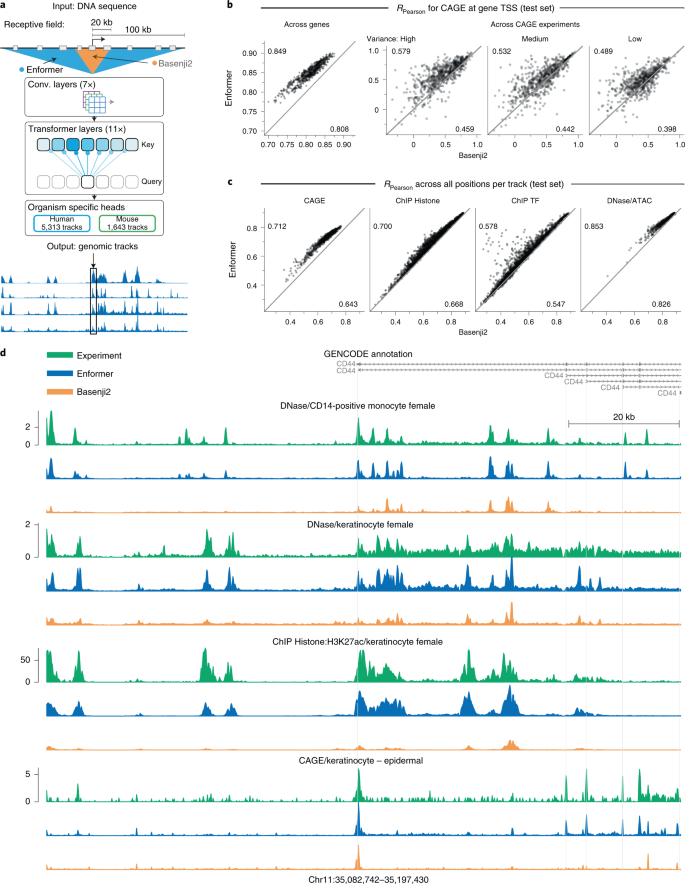
Figure 3. Enformer connects a long sequence window to named supervised assay outputs. Figure 1 from Avsec et al. (2021), unmodified, licensed under CC BY 4.0.
Borzoi chooses a related but distinct contract: 524 kb inputs and 32-base output bins for cell- and tissue-specific RNA-seq coverage. Its authors also report that tissue-specific alternative splicing was not learned well in their setup (Linder et al., 2025). A long supervised input supported some outputs and missed another. That is more informative than the window size by itself.
A useful practical evidence ladder starts with capacity and ends with intervention. A successful forward pass establishes capacity. Synthetic recall establishes that information can survive the architecture. Perplexity establishes distribution modelling. A distal ablation on the target endpoint tests task-relevant dependence. A prospective perturbation can test whether that dependence follows an intervention. Do not climb from the first rung to the last in one sentence (HyenaDNA; Enformer; Borzoi).
For a real task, run nested crop lengths with the same head and split. Occlude or shuffle distal intervals while preserving the focal sequence. Compare a shorter checkpoint, local motif and one-hot baselines, and an assay-specific specialist when one exists. If the output survives after distant bases are destroyed, that example did not demonstrate useful long-range dependence.
Which distribution and objective supplied the prior?
A corpus defines familiarity. An objective defines the cheap way to reduce loss. Neither guarantees transfer.
Original DNABERT, released HyenaDNA bases, and released Caduceus checkpoints use human-reference pretraining rather than population or multispecies sequence (Ji et al., 2021; HyenaDNA release; Caduceus-Ph card). DNABERT-2 moves to multispecies training, while Nucleotide Transformer provides human-reference, population, and 850-species branches (Zhou et al., 2024; Dalla-Torre et al., 2025). Those corpora encode different priors. Species count is not a monotonic quality metric.
GPN narrows the evolutionary question. The original single-sequence GPN learns from unaligned genomes and was demonstrated for Arabidopsis variants using related Brassicales species (Benegas et al., 2023). GPN-MSA consumes a multispecies whole-genome alignment at inference. Its checkpoint and data store must agree on assembly, species count, species order, and preprocessing; current project documentation retains inference assets but says the training path is not maintained and recommends GPN-Star (GPN-MSA documentation). GPN and GPN-MSA do not share the same input contract.
GenNA changes the prior again by placing nucleotide sequence, natural-language descriptions, species metadata, and structured annotations in one autoregressive stream. Its unreviewed 2026 preprint reports 2,221 eukaryotic species and about 416 billion characters (Shen et al., 2026, preprint). The reported semantic-mismatch and perplexity tests are developer-run, in silico evidence. Annotation consistency does not establish that a generated sequence performs the described function.
The objective boundary matters just as much:
- Masked encoders learn conditional token recovery from both sides of a gap. Their likelihoods and embeddings reflect that reconstruction objective (Ji et al., 2021; Dalla-Torre et al., 2025).
- Autoregressive systems such as Evo learn next-token prediction from a serialized prefix and can generate sequence. Their likelihood remains a score under that direction and distribution (Nguyen et al., 2024).
- Supervised systems such as Enformer and Borzoi optimise named experimental tracks. Their outputs inherit the cells, assays, target definitions, and biases of those labels (Avsec et al., 2021; Linder et al., 2025).
- Hybrid NTv3 post-training intentionally crosses the boundary from masked sequence modelling to supervised tracks and annotations. Name the pre-trained or post-trained checkpoint when reporting a result (Boshar et al., 2025, preprint).
Match the holdout to the proposed transfer. A chromosome holdout asks about new coordinates under a related distribution. A species or phylogenetic holdout asks about evolutionary transfer. A temporal holdout asks about future records only when corpus and benchmark snapshots are dated. “Multispecies” without a transfer test is a training-data label, not evidence of generalisation.
Is the model zero-shot, or is only the backbone frozen?
Evaluation terminology can hide more supervision than architecture diagrams reveal.
True zero-shot scoring applies a prespecified rule without fitting a task head. A masked model may compare alternate and reference probabilities at a locus. A causal model may compare normalised sequence likelihoods. Those are measurements of compatibility with a learned sequence distribution; neither becomes a functional assay by naming it a variant score (Benegas et al., 2023; Anderson et al., 2026).
A frozen-embedding experiment is different. The backbone stays fixed, but labels train a probe or downstream head. Layer choice, pooling, head capacity, optimiser, and split can all affect the final result. A peer-reviewed 2025 benchmark calls its extracted representations “zero-shot embeddings,” then trains supervised classifiers after pooling. Its authors report that mean token pooling improved sequence classification over other pooling choices in that protocol (Wang et al., 2025). That is evidence about a frozen representation and trained head, not label-free task prediction.
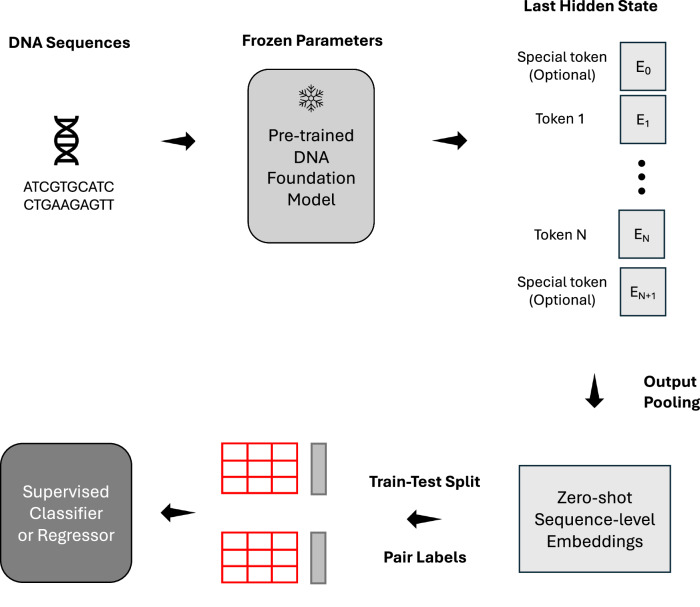
Figure 4. Frozen representation extraction is followed by pooling and a supervised task head. Figure 1 from Wang et al. (2025), unmodified, licensed under CC BY 4.0.
Use four explicit result labels:
- Untouched scoring: no task labels update a model or head.
- Frozen probe: the backbone is fixed while a labelled head is trained.
- Fine-tuning: labelled data update some or all backbone parameters.
- Supervised sequence-to-function: experimental tracks train the biological output directly.
For a controlled representation comparison, fix the extraction layer, pooling, head, label count, hyperparameter budget, and split. Sweep plausible layers rather than assuming the final layer is intrinsically best. For a best-system comparison, tune each model appropriately and say that the result compares complete systems. These are both useful experiments. Mixing them produces an impressive but uninterpretable table.
DART-Eval makes the separation visible across regulatory tasks. Its authors compare zero-shot, probing, fine-tuning, and ab-initio supervised baselines. In the retrieved unreviewed arXiv version 2 preprint, they report that simpler supervised models match or exceed larger fine-tuned DNA language models on several tested tasks, and that the tested language models perform poorly on their counterfactual tasks (Patel et al., 2025, unreviewed preprint). These are developer-reported conclusions within the benchmark's tested systems and implementations, not a universal ranking.
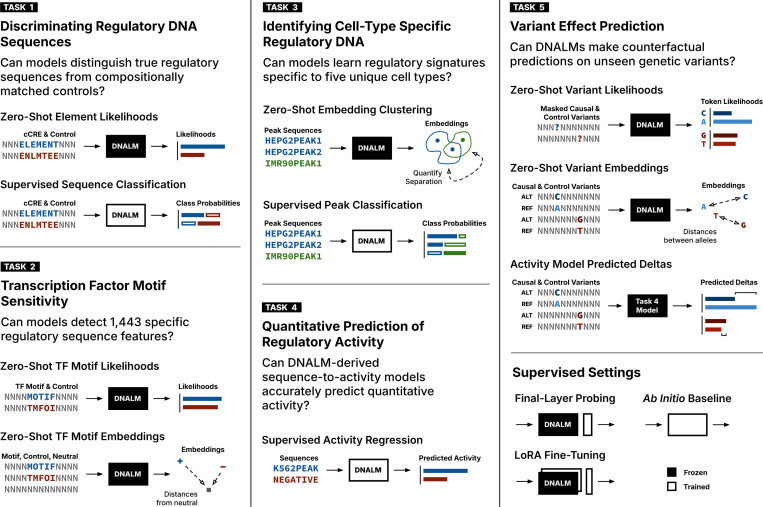
Figure 5. DART-Eval keeps adaptation regime, task type, and specialist baselines visible. Figure 1 from Patel et al. (2025), unmodified, licensed under CC BY 4.0. The source is an unreviewed arXiv version 2 preprint.
Variant scores need one more field: the operator. Masked log odds, causal sequence-likelihood ratios, embedding distances, alignment-conditioned evolutionary scores, and changes in supervised assay tracks have different units and assumptions (GPN; Evo; BEND; GPN-MSA; Enformer). Do not transfer thresholds or calibration across them without new validation. Report the checkpoint, objective, layer, pooling, head, label budget, split, and scoring operator beside every result.
Which claims does the evidence support?
For motif and sequence classification, the evidence supports specific transfer protocols. DNABERT reports fine-tuned downstream classifiers, Nucleotide Transformer reports low-cost fine-tuning, and Wang and colleagues evaluate frozen representations followed by supervised heads (Ji et al., 2021; Dalla-Torre et al., 2025; Wang et al., 2025). A good score can justify that backbone, extraction recipe, head, and split. It does not isolate an intrinsic, task-independent representation quality.
For variant effects, untouched masked or causal scores are testable hypotheses about a learned sequence distribution. GPN demonstrates a species-specific evolutionary scoring route from unaligned related genomes, while GPN-MSA requires an aligned multispecies input and publishes a separate human variant-scoring contract (Benegas et al., 2023; Benegas et al., 2025). These results support evaluation against population, association, or curated variant evidence in their stated settings. The GPN paper also says experimental validation of causal variants remains the gold standard.
For assay-defined outputs, supervised specialists provide the most direct evidence. Enformer predicts measured human and mouse tracks, Borzoi predicts RNA-seq and regulatory coverage, and AlphaGenome predicts multiple regulatory modalities under supervised training (Avsec et al., 2021; Linder et al., 2025; AlphaGenome, 2026). Their outputs remain bounded by cell types, assays, targets, and splits.
For generation, Evo, GENERator, and GenNA support sampling from different learned distributions, with different tokens, species coverage, and conditioning (Nguyen et al., 2024; Li et al., 2026, preprint; Shen et al., 2026, preprint). Likelihood, motif recovery, or semantic agreement can filter samples computationally. Functional language requires a separately specified validation stage.
What did the test set actually exclude?
“Held out” is not a biological property.
Genomic windows can overlap. Nearby loci share sequence and assay context. Reverse complements duplicate content. Homologous regions cross chromosomes and species. Population data can contain related haplotypes. A row-level random split can retain those relationships while looking statistically tidy. BEND supplies explicit split fields, but a split column proves only that rows were assigned somewhere (BEND repository). The unreviewed DART-Eval benchmark likewise shows why task, adaptation regime, and baseline must remain attached to a split-specific result (Patel et al., 2025, preprint).
Choose the exclusion that matches deployment. Use non-overlapping coordinate blocks or chromosomes to reduce local leakage. Cluster homologous sequence before splitting when the claim is family novelty. Hold out a species or clade for phylogenetic transfer. Use a temporal split for future data only if the model corpus and benchmark releases have known dates. Group donors, perturbation families, and experimental batches when they structure assay labels. These are study-design recommendations; each supports a different sentence in the conclusion.
Corpus overlap is broader than exact duplicate strings. Sequence sources can be updated after a benchmark's nominal date, and annotation-rich post-training can expose related targets. Archive the corpus snapshot, compare accession dates and coordinate ranges, search exact and reverse-complement matches, and mark homology or annotation checks that cannot be completed. Unresolved contamination is a result to report, not a blank to hide.
The downstream pipeline can add another source of variance. A 2025 preprint reports that BEND head-training scores changed with data-loader workers and shuffle buffers because genomic examples were autocorrelated in storage order (Greco and Rawlik, 2025, preprint). That finding is implementation-specific. It does show that fixed seeds without fixed example order and software versions are incomplete reproduction metadata.
Counterfactual sequences attack a different shortcut. Nullsettes creates in silico rearrangements of key regulatory elements in synthetic expression cassettes. The authors define the resulting virtual mutants as loss-of-function under canonical transcription and translation ordering constraints, then compare mutant and nonmutant likelihood distributions (Anderson et al., 2026).
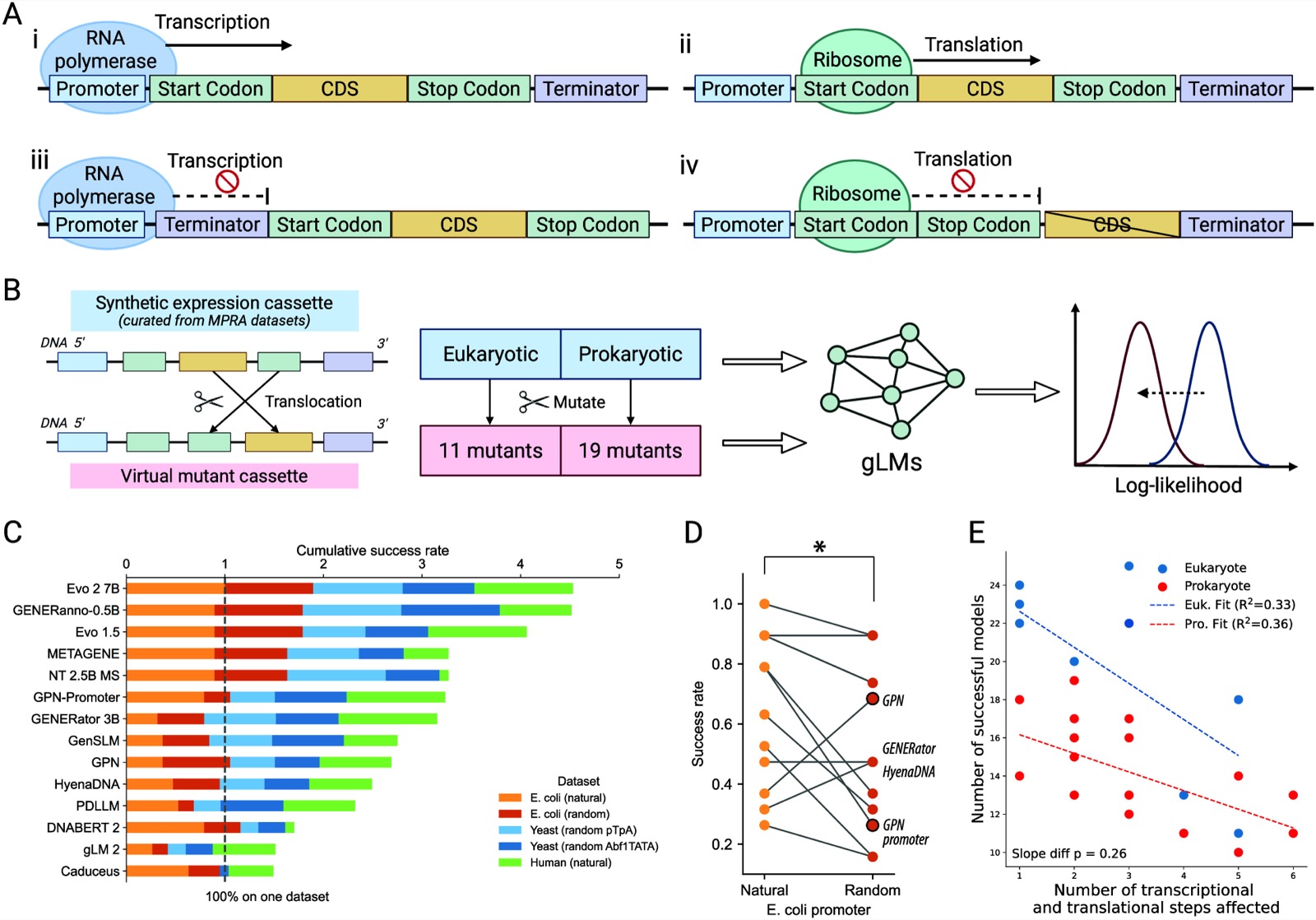
Figure 6. Nullsettes tests mutation-effect likelihood under deliberate distribution shift. Figure 1 from Anderson et al. (2026), uniformly resized from 3,900 × 2,725 pixels to 1,600 × 1,118 pixels, with no crop or content change, licensed under CC BY 4.0.
The peer-reviewed study reports frequent failures among most tested genomic language models, while also reporting Evo2-7B and GENERanno-0.5B as strong, consistent performers. Across the tested models, accuracy declines as the intact sequence receives lower model likelihood (Anderson et al., 2026).
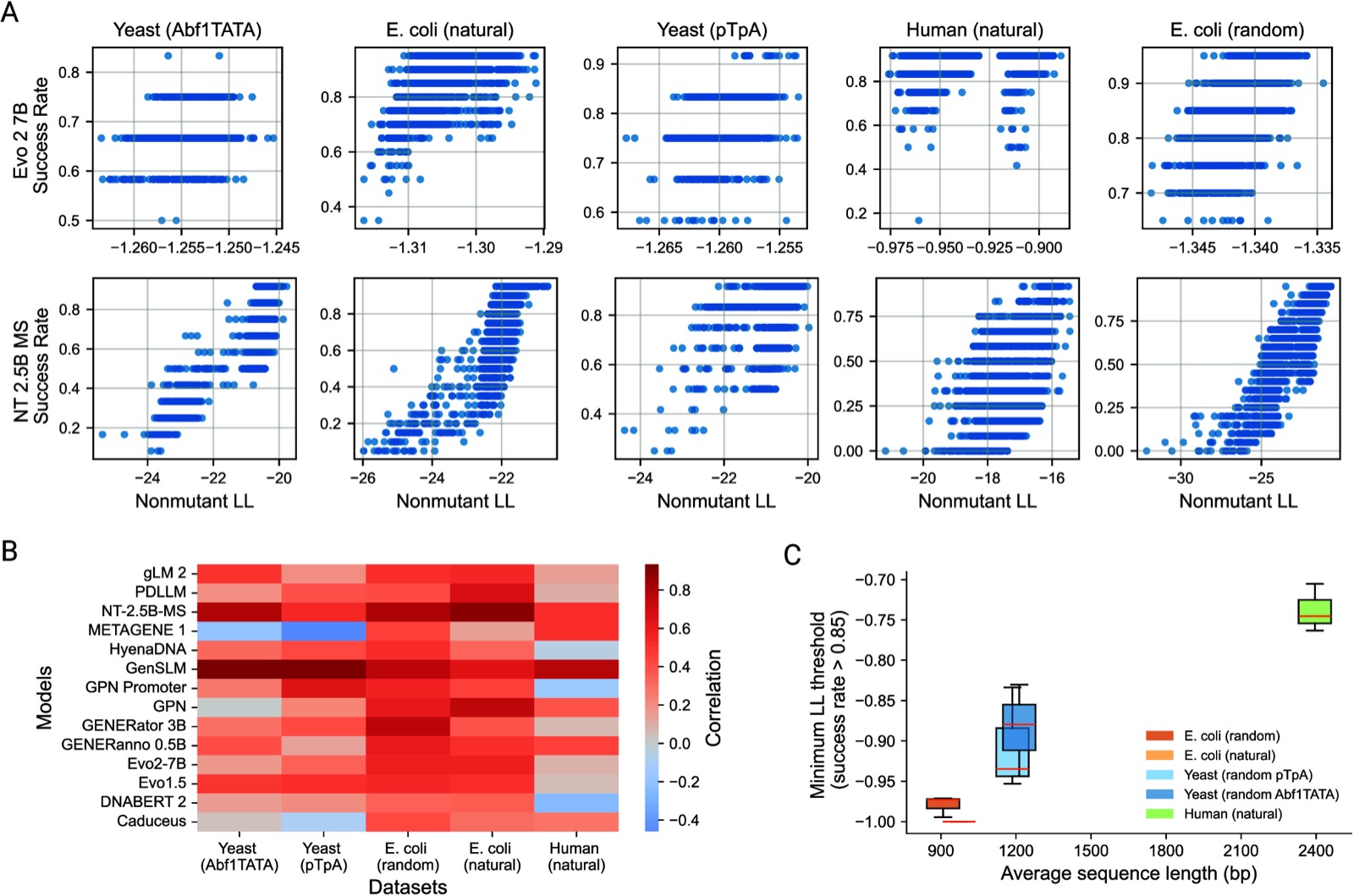
Figure 7. In the Nullsettes datasets, zero-shot mutation-effect accuracy degrades as the functional reference becomes less probable to the model. Figure 2 from Anderson et al. (2026), uniformly resized from 4,142 × 2,742 pixels to 1,600 × 1,059 pixels, with no crop or content change, licensed under CC BY 4.0.
Nullsettes is not an overall leaderboard, and its virtual constructs do not represent every natural-genome task. It falsifies a narrower inference within this benchmark: a construct designed to be nonfunctional under the benchmark's ordering rules can still receive a likelihood ordering that misses the disruption. Likelihood remains useful. The stress test tells us where the likelihood hypothesis breaks.
Run cheaper explanations under the same split. Include GC and k-mer features, one-hot sequence models, conservation, and a relevant supervised specialist. Add reverse-complement checks, distal-context ablations, and counterfactuals matched to the intended use. Report the simple model that wins.
Does “open” describe the artifact you need?
For this comparison, I treated a paper, code repository, checkpoint, prepared dataset, and hosted service as separate artifacts. Three release failures recur.
First, a licence does not automatically propagate to its neighbours. Nucleotide Transformer v1/v2 code and the inspected NT-v2 checkpoint card use CC BY-NC-SA 4.0 (NT repository licence; NT-v2 model card). NTv3's named checkpoints are auto-gated, tagged license: other, and governed by separate model terms; the repository's code licence is not the checkpoint licence (NTv3 100M record; NTv3 model terms). HyenaDNA code is Apache-2.0 while the selected Transformers-format 1M weight card declares BSD-3-Clause (HyenaDNA code; HyenaDNA 1M card). Caduceus code and the named Ph/PS cards declare Apache-2.0 (Caduceus code; Ph card; PS card).
GenNA's code is MIT, but its official public weight record does not state a weight licence (GenNA code; GenNA weights). Public download alone does not establish reuse permission; inspect the artifact's stated terms.
Second, a checkpoint can be runnable without making pretraining reconstructable. Original DNABERT and DNABERT-2 expose code and named weights, but the complete prepared corpora and their rights still require separate records (DNABERT release; DNABERT weight licence; DNABERT-2 release; DNABERT-2 weight licence). GENERator-v2's eukaryotic branch publishes code, MIT-labelled weights, and a named MIT-labelled pretraining dataset (GENERator repository; eukaryotic checkpoint; eukaryotic pretraining data). That is a stronger artifact claim than “data derived from RefSeq,” but upstream source records still retain their own terms.
Third, downloadable can still be operationally impractical. Evo 2 publishes Apache-2.0 code; the inspected 7B checkpoint card and OpenGenome2 dataset card independently declare Apache-2.0. Its official path says the 1B, 20B, and 40B models require FP8 through Transformer Engine on an NVIDIA Hopper GPU, while 7B has a different bfloat16 path (Evo 2 repository; Evo 2 7B card; OpenGenome2). This is a requirement of those official paths, not a universal speed ranking.
Borzoi exposes another practical boundary. Its code is Apache-2.0 and its official release links public weight files, but the inspected weight-download route does not state a separate weight licence. Its large training bucket is requester-pays (Borzoi paper; Borzoi release; weight-download script). “Weights downloadable” is the supported claim; “Apache-licensed weights” is not.
AlphaGenome shows why access descriptions age. It is a supervised sequence-to-function system in the peer-reviewed technical paper, not an annotation-free genomic language model (AlphaGenome, 2026). It is also no longer hosted-only. Google DeepMind provides an Apache-licensed research implementation, gated downloadable weights, and a hosted API. The weights use separate non-commercial model terms, and the service has its own terms (AlphaGenome research code; all-fold weights; model terms; service terms).
Archive the exact repository commit, model-card revision, checkpoint checksum, tokenizer, dataset version, accepted gate terms, precision, device, runtime, and peak memory. Prefer precise conclusions: “local inference is possible,” “weights are downloadable after accepting terms,” or “the prepared corpus was not released.” Reserve “reproducible” for the particular result actually rerun.
Choose by the failure you cannot tolerate
Model selection should be able to reject every candidate.
- Write the estimand. Choose a conditional allele probability, causal likelihood, embedding, labelled prediction, functional track, or generated sequence. Do not use “effect” as the unit.
- Freeze the coordinate and input contract. Pin assembly, coordinate convention, alleles, strand transform, tokenizer, crop, padding, ambiguous bases, species metadata, and any alignment.
- Match the prior. Choose human-reference, population, related-species, broad multispecies, all-domain, alignment-conditioned, or annotation-conditioned training because it fits the proposed transfer.
- Separate learning regimes. Put untouched scoring, frozen probes, full fine-tuning, post-trained hybrids, and supervised specialists in different result rows.
- Build the split before tuning. Remove coordinate overlap and redundancy, then add homology, species, temporal, donor, or perturbation separation when the claim requires it.
- Run cheap and specialist baselines. Compare k-mer or one-hot models, conservation, and the relevant assay or evolutionary specialist under the same labels and split.
- Attack the result. Test the correctly transformed reverse complement, perturb distal context, vary layer and pooling, repeat seeds, and add an appropriate counterfactual or distribution shift.
- Clear the release. Resolve code, checkpoint, data, service terms, and compute before the expensive experiment begins.
Figure 8. Selection proceeds from a task-specific route through input, split, baseline, stress-test, artifact, and compute gates, with rejection as a valid result. Sources: GPN, GPN-MSA, Enformer, Borzoi, BEND, the unreviewed DART-Eval version 2 preprint, Wang et al., and Nullsettes.
Predeclare an output-specific stop condition. Reject an embedding advantage that disappears under a fixed head or homology-aware split. Where a versioned conservation score is applicable, reject a claimed zero-shot advantage that cannot beat it under the same variants, coverage, metric, and split; also reject a score that fails the counterfactual matching its intended use. Reject a functional-track gain that vanishes in the required cell type or under distal-context ablation.
Stop a generation claim at the validation boundary declared in advance. Sequence checks can support sequence-distribution or motif claims, and structural checks can support structural-plausibility claims; neither establishes biological function. Make a functional claim only when a relevant experimental assay validates that function.
This process may select a compact evolutionary scorer, a frozen encoder with a fixed probe, a supervised assay predictor, or an autoregressive generator. It may select a one-hot model. It may reject every available system. Those are useful outcomes.
From DNA to RNA
A credible genomic-model claim names the full system: assembly, tokenizer, strand rule, context, checkpoint, adaptation, endpoint, split, baselines, and shifts. Tensor size does not change that evidential standard.
A reference DNA window also does not determine which transcript is present in a particular cell and condition, which splice form survives, how bases are modified, what structure forms, or how long the molecule persists. Part 6 moves to RNA foundation models, where sequence remains the substrate but molecular state becomes part of the representation problem.
References
- Ji Y, Zhou Z, Liu H, Davuluri RV. DNABERT. Bioinformatics. 2021.
- Zhou Z, Ji Y, Li W, et al. DNABERT-2. ICLR. 2024.
- Dalla-Torre H, Gonzalez L, Mendoza-Revilla J, et al. Nucleotide Transformer. Nature Methods. 2025.
- Boshar S, Evans B, Tang Z, et al. Nucleotide Transformer v3. bioRxiv preprint. 2025.
- Nguyen E, Poli M, Durrant MG, et al. HyenaDNA. NeurIPS. 2023.
- Schiff Y, Kao C-H, Gokaslan A, et al. Caduceus. ICML. 2024.
- Nguyen E, Poli M, Durrant MG, et al. Evo. Science. 2024.
- Brixi G, Durrant MG, Ku J, et al. Evo 2. Nature. 2026.
- Li Q, Zhan Z, Feng S, et al. Functional In-Context Learning in Genomic Language Models. bioRxiv preprint. 2026.
- Shen Y, Cao G, Wu J, et al. GenNA. bioRxiv preprint. 2026.
- Benegas G, Batra SS, Song YS. GPN. PNAS. 2023.
- Benegas G, Albors C, Aw AJ, et al. GPN-MSA. Nature Biotechnology. 2025.
- Avsec Z, Agarwal V, Visentin D, et al. Enformer. Nature Methods. 2021.
- Linder J, Srivastava D, Yuan H, et al. Borzoi. Nature Genetics. 2025.
- Marin FI, Teufel F, Horlacher M, et al. BEND. ICLR. 2024.
- Patel A, Singhal A, Wang A, et al. DART-Eval. Unreviewed arXiv preprint, version 2. 2025.
- Wang T, Wei P, Wu C, et al. Benchmarking DNA foundation models for genomic and genetic tasks. Nature Communications. 2025.
- Anderson AS, et al. Evaluating DNA Function Understanding in Genomic Language Models Using Evolutionarily Implausible Sequences. ACS Synthetic Biology. 2026.
- Ma M. Reverse-Complement Consistency for DNA Language Models. Unreviewed arXiv preprint. 2025.
- Greco D, Rawlik K. Same model, better performance. arXiv preprint. 2025.
- Avsec Ž, Latysheva N, Cheng J, et al. Advancing regulatory variant effect prediction with AlphaGenome. Nature. 2026.
- DNABERT authors. DNABERT repository and DNA_bert_6 weight licence. Retrieved 2026-08-28.
- MAGICS Lab. DNABERT-2 repository and 117M weight licence. Retrieved 2026-08-28.
- InstaDeepAI. Nucleotide Transformer repository licence, NT-v2 500M multispecies card, NTv3 guide, NTv3 100M record, and NTv3 model terms. Retrieved 2026-08-28.
- HazyResearch and LongSafari. HyenaDNA code and 1M checkpoint card. Retrieved 2026-08-28.
- Kuleshov Group. Caduceus repository, Ph checkpoint, and PS checkpoint. Retrieved 2026-08-28.
- LongSafari. OpenGenome. Retrieved 2026-08-28.
- Arc Institute. Evo 2 repository, 7B checkpoint, and OpenGenome2. Retrieved 2026-08-28.
- GenerTeam. GENERator repository, v2 eukaryotic checkpoint, and eukaryotic pretraining data. Retrieved 2026-08-28.
- GenNA authors. GenNA repository and official checkpoint. Retrieved 2026-08-28.
- Song Lab. GPN-MSA documentation. Retrieved 2026-08-28.
- Google DeepMind. AlphaGenome research implementation, all-fold weights, model terms, and service terms. Retrieved 2026-08-28.
- Calico Life Sciences. Borzoi repository and weight-download script. Retrieved 2026-08-28.
- BEND authors. BEND benchmark repository. Retrieved 2026-08-28.
Comments and feedback
Spotted an error or have a counterpoint? Comment below. No account needed, a name is enough. Corrections and pushback are welcome.